

Self-love does not have to mean feeling confident, enjoying every moment alone or replacing every critical thought with an affirmation. It can be an ordinary way of treating yourself: noticing a need, allowing a limit or asking for help when something is difficult.
You can care about other people and receive their love while still struggling with how you see yourself. The ideas below are options for everyday care, not signs you must collect to prove that you are worthy of a relationship. Choose one that feels useful and adapt it to your circumstances.
On this page
1. Notice a current need
Start with a practical question: “What would make the next part of today more manageable?” You might need food, rest, company, a quieter space or help with a task. Responding to one need can be worthwhile even if you do not feel especially positive about yourself.
Keep care realistic. A meal does not have to be elaborate, movement does not have to be a workout and rest does not have to follow a productive day. Money, disability, caring responsibilities and access to facilities can affect what is possible. Choose an available option rather than a standard that adds pressure.
For example, if you have been putting off lunch while finishing a task, you could pause for something simple to eat. If you need company, send a specific invitation: “Would you have time for a short call this evening?” Care can include connection as well as time alone.
2. Give yourself a fairer account
Notice the difference between describing a difficulty and judging your whole character. “I missed that deadline” gives you something to address. “I ruin everything” makes a much broader claim. You do not need to force a cheerful opposite; try a statement that leaves room for the facts and your next choice.
The NHS guidance on low self-esteem suggests examining negative beliefs and considering evidence that challenges them. You might write, “I found this task difficult, and I can ask which part needs attention first.” Keep the response credible to you, rather than repeating words you feel obliged to believe.
Self-kindness can also include responsibility. If you hurt someone, you can acknowledge what you did, apologise and discuss repair without deciding that you are beyond care. Respecting yourself does not require pretending that every choice was helpful or that other people’s concerns do not matter.
3. Make room for limits and support
A limit can describe what you have capacity for: “I can help for half an hour,” or “I cannot take that on this week.” You may feel uncomfortable saying it. Discomfort does not automatically mean the limit is wrong, and confidence is not a prerequisite for having one.
Other people have limits too. If a friend cannot be available, consider another source of support rather than treating their answer as a measure of your worth. You can ask clearly for what would help, while leaving them free to say what they can offer.
Notice whether relationships leave room for your needs and choices. You do not have to remain endlessly available to prove that you care. If someone responds to a limit with threats or intimidation, seek trusted or specialist support about a safer approach rather than handling the situation alone.

4. Choose interests without comparison rules
You may want to learn something, return to an interest or spend time with people you enjoy. Ask what appeals to you now, rather than what would make your life look impressive. A modest activity can count without becoming a personal improvement project or a public achievement.
Comparison and jealousy can still show up. You can be pleased for a friend and disappointed about your own circumstances at the same time. Instead of using the feeling as proof that you lack self-love, ask whether it points to something you want, a loss you need to acknowledge or a reminder you would like less often.
Gratitude, spiritual reflection or affirmations may be meaningful practices for you. Use them if they help you reflect, without requiring them to remove every difficult feeling or bring a particular outcome. Being positive does not make you responsible for everything that happens to you.
5. Keep care flexible on difficult days
A plan can become smaller when your circumstances change. If a long walk no longer fits, you might choose a short time outdoors or a different restful activity. Revising a plan is not necessarily breaking faith with yourself; it may be an honest response to the resources you have today.
If low self-worth is persistent, distressing or interfering with everyday life, consider discussing it with a qualified professional. You can explain the particular difficulty you want help with and ask about their approach, fees and confidentiality. Receiving support does not mean that you failed to care for yourself.
For now, try one specific commitment: “I will pause before taking on another task,” or “I will ask for company tonight.” You can review how it worked later. You do not need to achieve a permanent state of self-love before you deserve ordinary kindness, including your own.
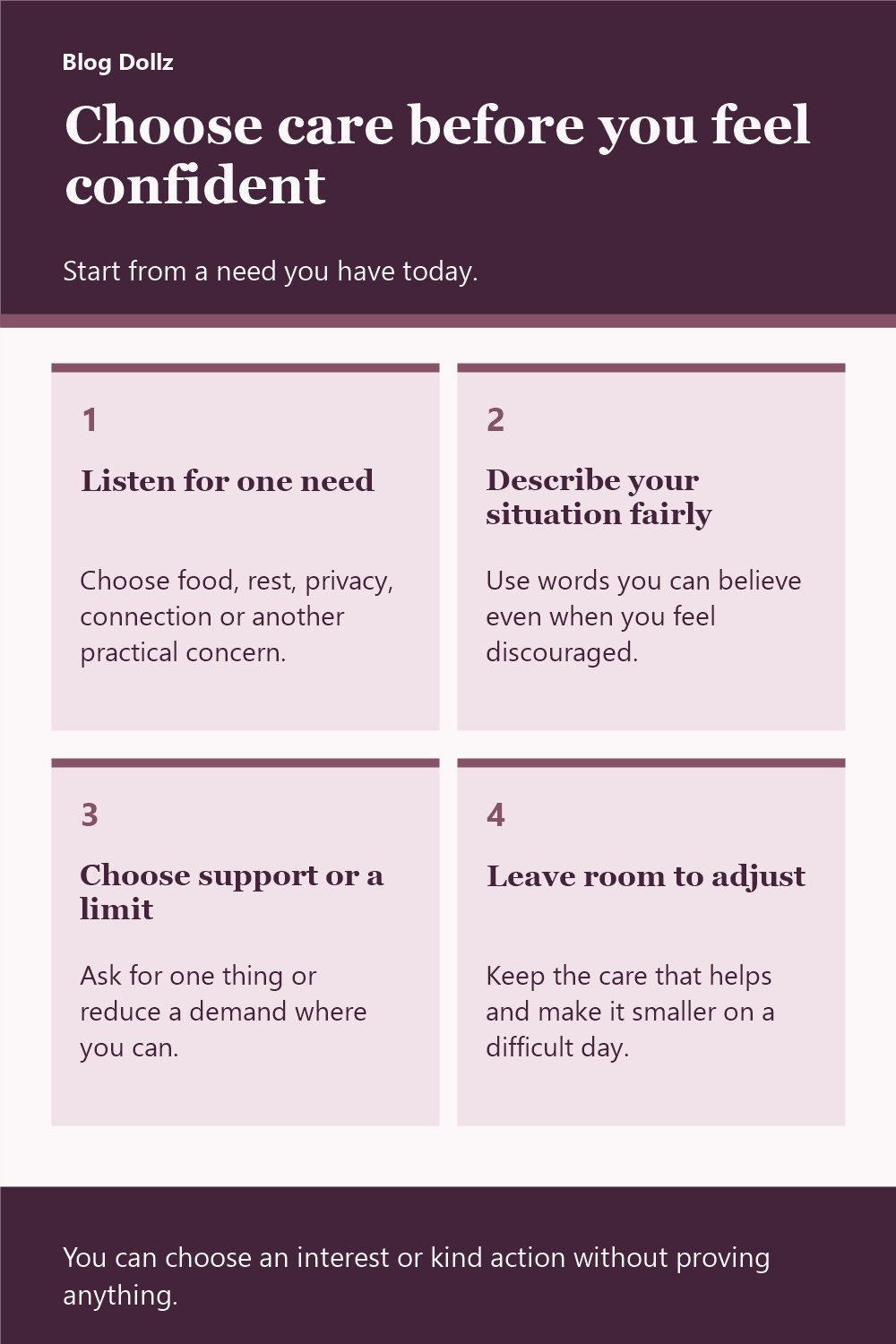
Read the infographic in text
Choose care before you feel confident Start from a need you have today.
- Listen for one need Choose food, rest, privacy, connection or another practical concern.
- Describe your situation fairly Use words you can believe even when you feel discouraged.
- Choose support or a limit Ask for one thing or reduce a demand where you can.
- Leave room to adjust Keep the care that helps and make it smaller on a difficult day.
You can choose an interest or kind action without proving anything.