

A promise to yourself can help you protect something that matters: time to rest, a task you want to finish or an interest you miss. But a missed commitment does not prove that you are unreliable, unworthy or failing to care about yourself.
Instead of making a stricter promise, look at what you asked of yourself and what happened. A smaller, clearer agreement may be more useful than another demand to try harder.
On this page
Review the promise without blame
Think of one recent commitment rather than judging your entire character. What did you intend to do? What got in the way? Was the task unclear, too large or competing with responsibilities you could not postpone?
You may also have changed your mind about the goal. That deserves a review, not an automatic accusation that you are making excuses. A promise made under pressure may not reflect what you want now.
Be specific about the obstacle. “I was too tired after work to complete an hour of study” gives you something to reconsider. “I never follow through” leaves the next step unclear.
Choose a commitment that fits
Decide what matters enough to keep space for, then check the resources it requires. Consider time, energy, access, money and help from other people. A plan should fit your actual week rather than an ideal week with no interruptions.
Treat the commitment as you would a reasonable agreement with a friend: take it seriously, communicate a change and allow for illness or unexpected demands. Care does not require refusing every necessary adjustment.
You might replace “I will read every evening for an hour” with “I will read a few pages on two evenings this week.” If even that is too much, choose a smaller step or postpone it deliberately. Rest can also be something you plan to protect.
Make the first step clear
Define an action you can recognise when it is done. “Organise everything” is difficult to finish. “Put the papers needed for tomorrow’s appointment in one folder” has a clear stopping point.
- Choose when and where the action could happen.
- Make any needed materials easy to reach.
- Decide what counts as enough for this attempt.
A reminder may help, but avoid building a system that takes more effort than the task. One visible note or a single calendar entry may be sufficient. You do not need a perfect tracking streak to make an action worthwhile.
Plan for interruptions
Decide in advance what you could do if the original plan becomes unrealistic. Your alternative might be a shorter version, a different day or a conscious decision to let the task wait.
For example: “If the evening is taken up by care responsibilities, I will look at tomorrow’s schedule and choose another time.” This is a way to respond to a real constraint, not a guarantee that every task will get done.
If you miss a step, avoid creating a punishing catch-up plan. Look at what is still necessary and choose the next manageable action. You can restart without doubling the demand.
Rebuild through review and support
After trying the plan, ask what helped and what needs changing. Keep a simple record if useful: what you intended, what happened and what you will adjust. The purpose is information rather than a score of your worth.
Another person can offer encouragement or practical help if you want it. Be clear about the role: a reminder, shared work time or help reducing a responsibility. Accountability should not involve shame, monitoring you have not agreed to or pressure to ignore your limits.
If persistent distress or exhaustion makes everyday tasks difficult, consider appropriate professional support. For an everyday next step, choose one promise small enough to review honestly. Following through and revising a plan can both be ways of taking your needs seriously.
Related reading: Setting Goals to Improve Yourself.
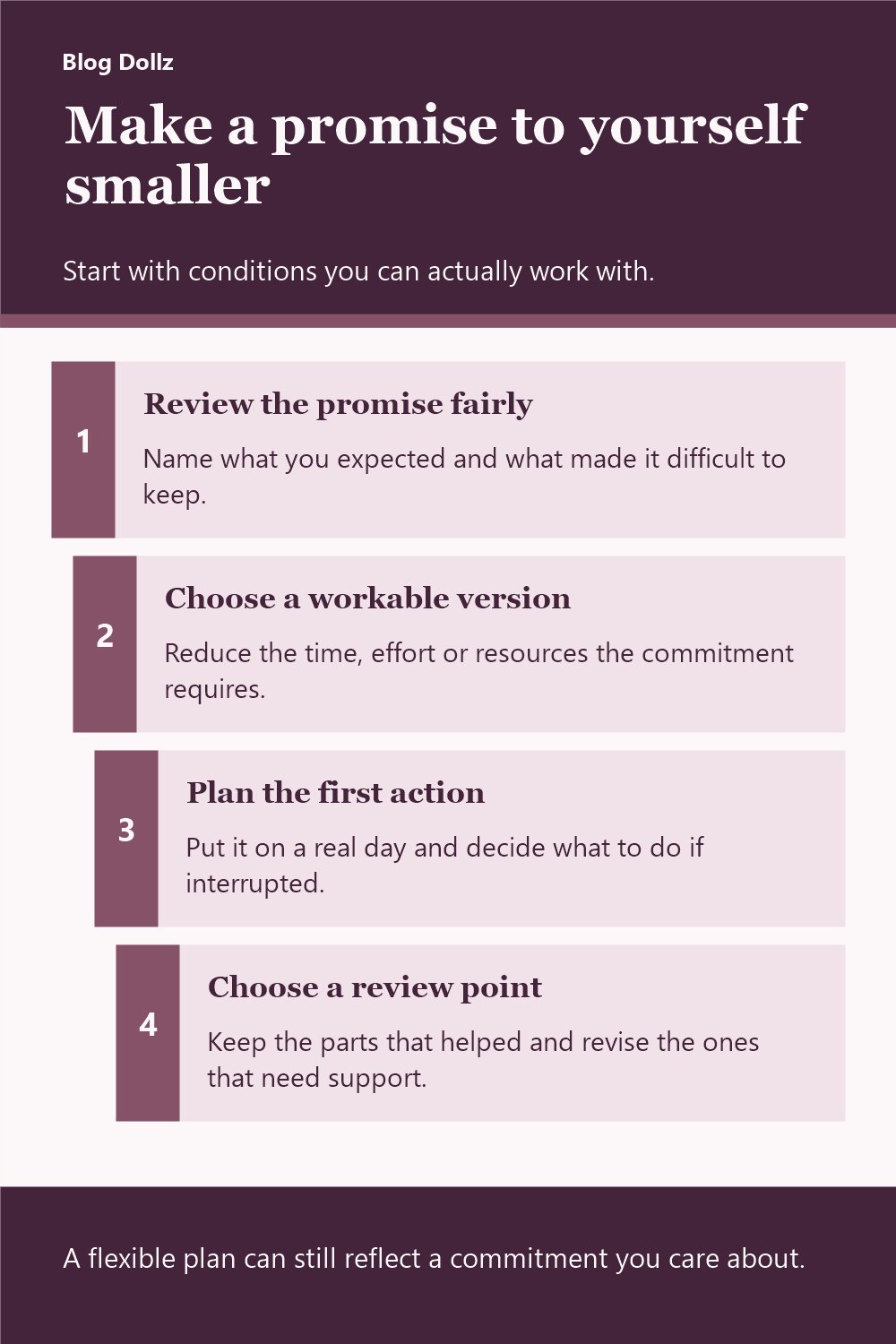
Read the infographic in text
Make a promise to yourself smaller Start with conditions you can actually work with.
- Review the promise fairly Name what you expected and what made it difficult to keep.
- Choose a workable version Reduce the time, effort or resources the commitment requires.
- Plan the first action Put it on a real day and decide what to do if interrupted.
- Choose a review point Keep the parts that helped and revise the ones that need support.
A flexible plan can still reflect a commitment you care about.