

A friendship can feel one-sided when you repeatedly make the plans, provide support or leave conversations feeling dismissed. That experience deserves attention. It does not automatically tell you what the other person intends, and you do not need to prove someone is “fake” before changing how much you give.
Look at what happens over time, how it affects you and what happens when you ask for something different. Those details can help you decide whether to repair the friendship, adjust your expectations or step back.
On this page
1. Look at a pattern, with context
Think of a few specific examples. Did a friend cancel repeatedly without suggesting another time? Do they contact you mainly for favours? Have they shared private information after you asked them not to? Describe the behaviour rather than guessing their motives.
A demanding job, illness, caring responsibilities or a different communication style can affect someone’s availability. Context can explain a missed call; it does not require you to accept repeated disrespect. Both their capacity and your needs matter.
Reciprocity also need not look identical. You might organise outings while your friend checks in after difficult appointments. Ask whether care travels in both directions in ways you each recognise, rather than counting every message.
2. Separate support from agreement
A caring friend can disagree with a decision or keep another friendship after your breakup. Taking your side in every conflict is not the only way to show loyalty. Someone can listen, respect your privacy and offer a different perspective without humiliating you.
There is a difference between a respectful concern and repeated put-downs. “I’m worried that plan could leave you short of money” offers something to consider. Mocking you in front of others, threatening to reveal secrets or treating a boundary as a joke is a more serious problem.
Similarly, a friend having a partner or other friends does not mean you have been replaced. What matters is whether there remains a workable place for your friendship, rather than an expectation of constant availability.

3. Ask clearly for what you need
If a conversation feels safe and worthwhile, choose one example and one request. You might say, “I’ve arranged our last few meetups. Would you choose a time for the next one?” Or, “I told you that privately. Please don’t share it again.”
Give the other person room to explain without abandoning your point. A useful response includes listening and a realistic change. An apology can matter, but notice what happens afterwards as well.
If they cannot offer what you need, that information may help you set different expectations. You do not have to argue them into being a closer friend. You can decide that occasional contact works better than relying on them for sensitive support.
4. Set a boundary you can maintain
A boundary describes what you will do or participate in. “I can’t lend money” is clearer than continuing to lend while hoping the friend recognises your resentment. “I’ll leave the conversation if the jokes about me continue” gives you a specific action.
You can decline a favour, keep some information private or make fewer plans without staging a secret test. Deliberately withholding contact to see whether someone “passes” can create more uncertainty. State your needs directly where you can.
If you fear retaliation, harassment or exposure of private information, prioritise safety and get support from someone you trust. You do not owe a confrontation or a detailed explanation that makes you feel less safe.
5. Choose what comes next
Consider whether the friendship feels more respectful after a clear request, whether both of you want to maintain it and whether the contact is sustainable. You might repair a misunderstanding, become less close or end the relationship.
Stepping back can still bring sadness. Missing someone does not erase the reasons you changed the relationship. Keep room for other connections and activities so one friendship does not have to meet every need.
A useful question is, “What level of contact lets me act with care for both of us?” Your answer can change as circumstances and behaviour change.
Read the infographic in text
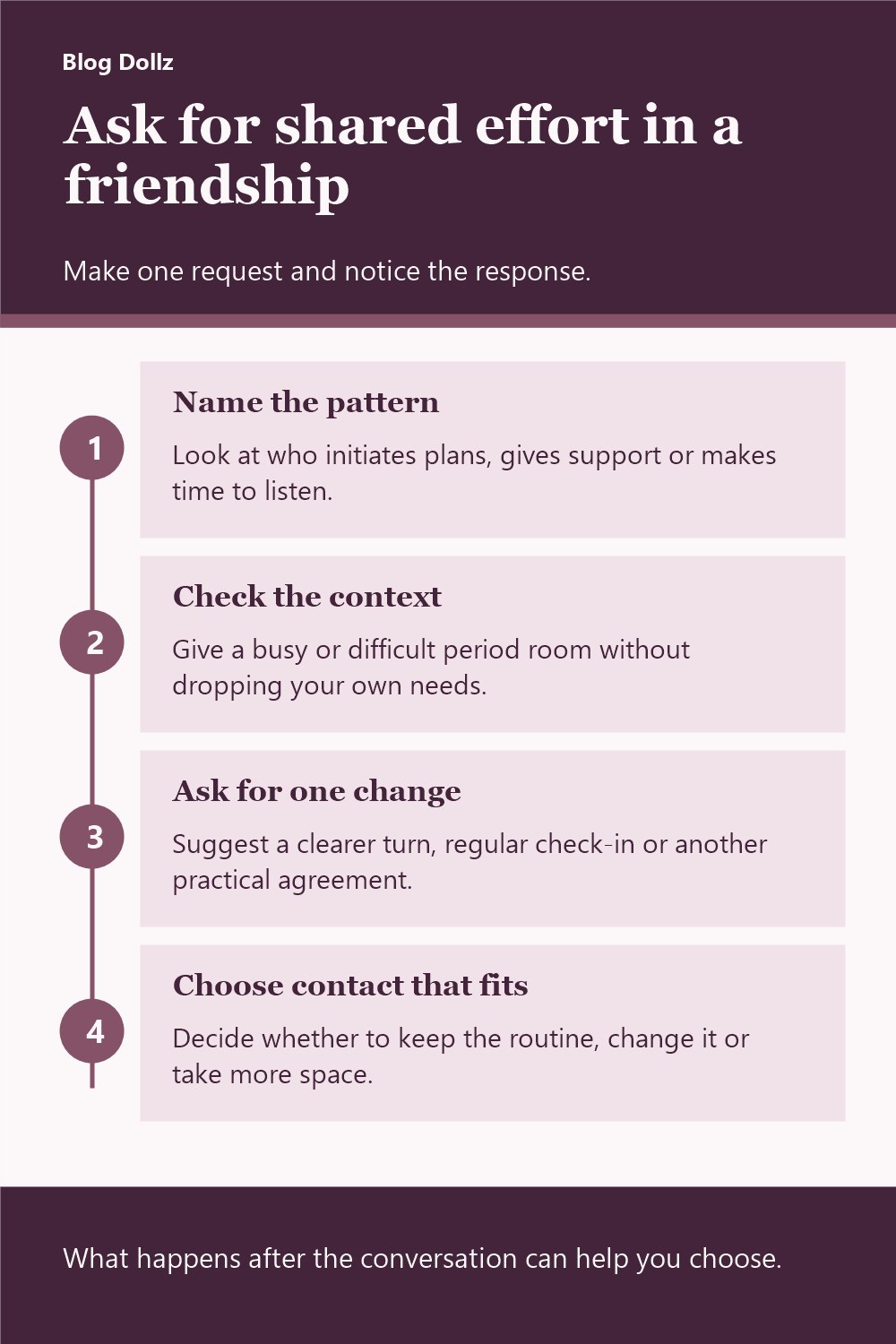
Ask for shared effort in a friendship Make one request and notice the response.
- Name the pattern Look at who initiates plans, gives support or makes time to listen.
- Check the context Give a busy or difficult period room without dropping your own needs.
- Ask for one change Suggest a clearer turn, regular check-in or another practical agreement.
- Choose contact that fits Decide whether to keep the routine, change it or take more space.
What happens after the conversation can help you choose.