

Single parenting can involve many responsibilities and very different family circumstances. You may be parenting alone by choice, after a separation or loss, or as part of an arrangement that changes over time. Your family structure does not measure how much you care about your child.
When the daily load feels heavy, start with what needs attention now and what support is realistically available. You do not have to perform every role perfectly or keep the household looking as though one adult has unlimited time.
On this page
Choose the priorities that matter today
Separate immediate care needs from tasks that can wait. Food, necessary appointments, safe supervision and something needed for the next school day may come before a full clean or an elaborate activity. A smaller plan can still take care of what matters.
Look for one task you can simplify. You might repeat a familiar meal, keep essential items in one place or reduce the number of errands in a week. Choose an arrangement that works for your household rather than a routine built for someone else’s circumstances.
When plans change, decide what to drop as well as what to add. You do not need to carry yesterday’s whole unfinished list into an already difficult day. A plan should help you make choices, not keep a record of everything you could not fit in.
Ask for specific, suitable support
People may find a clear request easier to answer: “Could you collect the groceries on Tuesday?” or “Could you stay with the children while I attend this appointment?” Ask about the person’s actual capacity and agree on the details instead of relying on an open-ended offer.
For childcare, consider your child’s needs and the caregiver’s suitability, experience and reliability. Check relevant local requirements, ask questions and agree on practical instructions and contact details. A familiar person is not automatically the right person for every situation.
Another parent may be part of the support available, but only where that contact is safe and appropriate to your circumstances. Do not assume that an unsafe or unavailable former partner is a solution. Seek suitable local professional guidance if care arrangements or safety concerns need attention.
Support does not have to mean paying for a cleaner or another service you cannot afford. Ask local family services, schools or community organisations what practical help is available. In England and Wales, Gingerbread’s support for single parents includes information and ways to connect with other parents. Elsewhere, look for services covering your own area.
Make breaks fit your child’s care needs
A break depends on safe care and supervision, so advice to “take time for yourself” may not be simple to follow. If another suitable adult can help, agree on a realistic time. If that is not available, consider a smaller pause that fits what your child can safely do with you nearby.
A pause does not need to become another improvement project. You might sit down with a drink, listen to something you enjoy or have a brief conversation with a supportive adult. Choose what offers some relief rather than what looks like ideal self-care.
Keep adult emotional support separate from your child’s responsibilities. Children can have age-appropriate household tasks and be included in ordinary routines, while adults remain responsible for care and for finding support with adult worries.
Protect rest without adding an earlier alarm
Look at what is taking time from rest and whether any part can be changed. Preparing one essential item ahead, sharing a task where possible or leaving non-urgent housework may be more helpful than trying to complete everything after the children are asleep.
Waking earlier is not automatically a solution if you are already short of sleep. You may value quiet time in the morning, but it should not become another rule you must follow to be a good parent. Consider the rest you need as well as the time you want alone.
Some periods are difficult to organise around, including night waking, illness or changing work hours. You can ask for help and adjust expectations during those periods. Difficulty getting enough rest is not evidence that you do not care enough.
Use realistic expectations and repair
Children and adults have difficult days. If you speak harshly, a brief apology can name your action without making your child responsible for comforting you: “I shouted. That was not a good way to speak to you. I will pause before we try this again.”
Look at what would make the situation more manageable next time: less rushing, clearer instructions, an earlier request for help or a task you can leave until later. Repair includes changing something practical where you can, rather than demanding that you never feel overwhelmed.
If the strain feels unmanageable or is affecting daily life, speak with a qualified professional or local family-support service. You deserve support alongside your child. Being a caring parent does not require doing everything alone.
Read the infographic in text
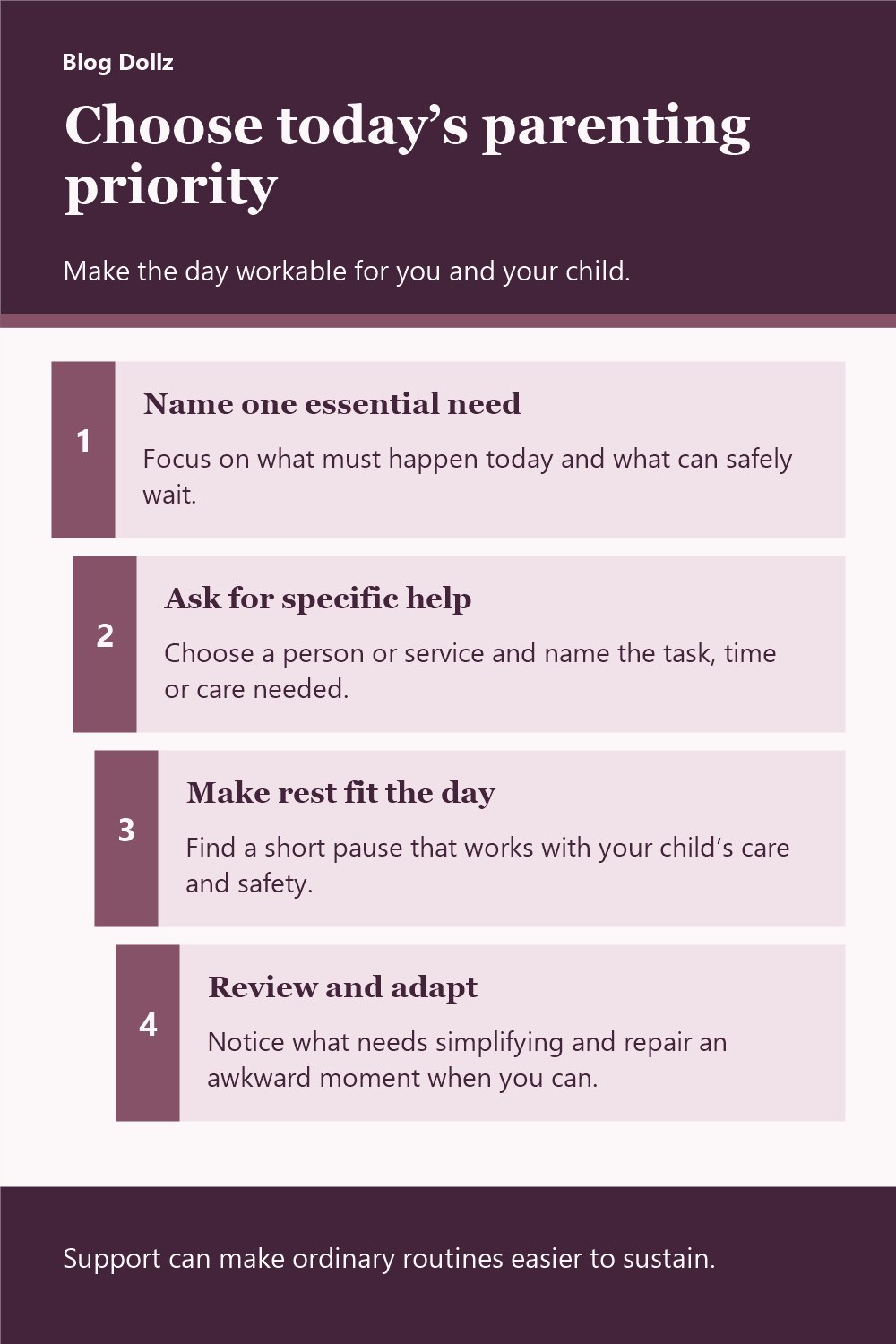
Choose today’s parenting priority Make the day workable for you and your child.
- Name one essential need Focus on what must happen today and what can safely wait.
- Ask for specific help Choose a person or service and name the task, time or care needed.
- Make rest fit the day Find a short pause that works with your child’s care and safety.
- Review and adapt Notice what needs simplifying and repair an awkward moment when you can.
Support can make ordinary routines easier to sustain.