

Turning 30 can feel exciting, ordinary, unsettling or all three. A birthday may bring questions about relationships, work, family, money or the life you imagined. It does not automatically give you confidence, clear priorities or a finished plan.
You can use the milestone as an invitation to reflect, without treating it as a deadline. Start with your actual circumstances and choose something that would make everyday life more workable.
On this page
Treat the birthday as a milestone, not a deadline
Your worth does not depend on being married, having children, owning a home or reaching a particular job title by 30. Wanting any of those things is valid. So is wanting something different or still working out what you want.
Comparisons can blur the difference between your wishes and someone else’s timetable. When a friend’s announcement stings, ask what it brings up for you: a real hope, a fear of being left out or pressure to prove that you are doing well.
You do not have to turn the birthday into a makeover. Choose a celebration, a quiet day or no special event according to your energy, preferences and resources.
Accepting where you are does not mean approving of everything in your life. You can acknowledge disappointment and still describe the present fairly, without calling yourself a failure.
Try finishing this sentence: “For me, a worthwhile next chapter would include more…” Name something you can recognise in daily life, such as reliable friendship, time to learn or less rushing.
Choose what matters in your actual circumstances
Separate a wish from an immediate need. You might want a new career while needing steadier hours first, or hope for a relationship while needing time to recover from a difficult one. Both parts of that situation matter.
Pick one area to review: work, relationships, home, money, health or rest. Write down what is working, what is difficult and one change within reach. You do not need to reorganise every part of life at once.
Make room for ordinary sources of enjoyment, too. A familiar meal, a conversation or an absorbing hobby can belong in your plans alongside longer-term goals. Enjoyment is not something you must earn by achieving enough.
Travel and big experiences are options, not proof of a life well lived. If a trip is out of reach or simply unappealing, consider an affordable local outing or time at home doing something you value.
Other people’s choices may differ from yours. You can stay curious about their lives without adopting their plans. Shared respect does not require everyone to marry, parent, work or socialise in the same way.
Make room for limits and everyday support
Saying no is a skill you can practise at any age. Try a clear sentence: “I can’t take that on this week,” or “I can help for an hour.” You do not need a birthday to justify a reasonable limit.
Look at what makes basic care easier in your circumstances. That might mean protecting a rest period, arranging help with a task or keeping a routine simple enough to manage. Care is not a competition in discipline or appearance.
Choose moments when you want to give someone your attention. You might put your phone aside during a meal or agree on a time to talk. Being present does not require being available to everyone throughout the day.
Ask for support specifically: “Could you listen while I think this through?” or “Would you check in next week?” Let the other person say what they can offer, and consider more than one source of support.
You do not have to remove everyone who disagrees with you. Notice patterns of respect, pressure and repair instead. For practical language, read Standing Up for Yourself: Clear Words, Choices and Support.
Try a small change before a big commitment
Learning does not have to begin with an expensive course or a complete change of direction. Read about an interest, talk with someone who knows the area or try a short activity before deciding whether to do more.
Before taking a risk, consider the time, cost, support and responsibilities involved. A smaller version of the idea may teach you something useful while leaving room to reconsider.
Not every opportunity deserves a yes. Ask whether it fits what matters to you, what it would displace and whether you have enough information to decide. Passing on an opportunity can be a deliberate choice.
Confidence can be uneven. The NHS guide to self-esteem suggests noticing strengths, questioning harsh beliefs and practising assertiveness. You can work on those skills without expecting to feel confident all the time.
After a small experiment, ask what you learned rather than whether you succeeded perfectly. Keep what helps, adjust what does not and decide whether the next step still makes sense.
Leave room to change your mind
If trusting the universe is meaningful to you, it can sit alongside practical planning and your own judgment. A spiritual belief does not have to promise that everything will work out or explain why something difficult happened.
Humour and good company may offer welcome moments of relief. You do not have to laugh through pain or turn every experience into a positive lesson.
Feeling upset does not mean you are immature. If persistent self-criticism or low confidence is making daily life difficult, consider speaking with a healthcare professional or a qualified counsellor about support.
Treat yourself with the same consideration you would offer someone you care about. You can take responsibility for a mistake without turning it into a judgment about your whole character.
Choose one manageable step for the coming week, then review it when you have more information. Your thirties can contain learning, uncertainty, pleasure and change. You do not need to know the whole story before living the next part.
Read the infographic in text
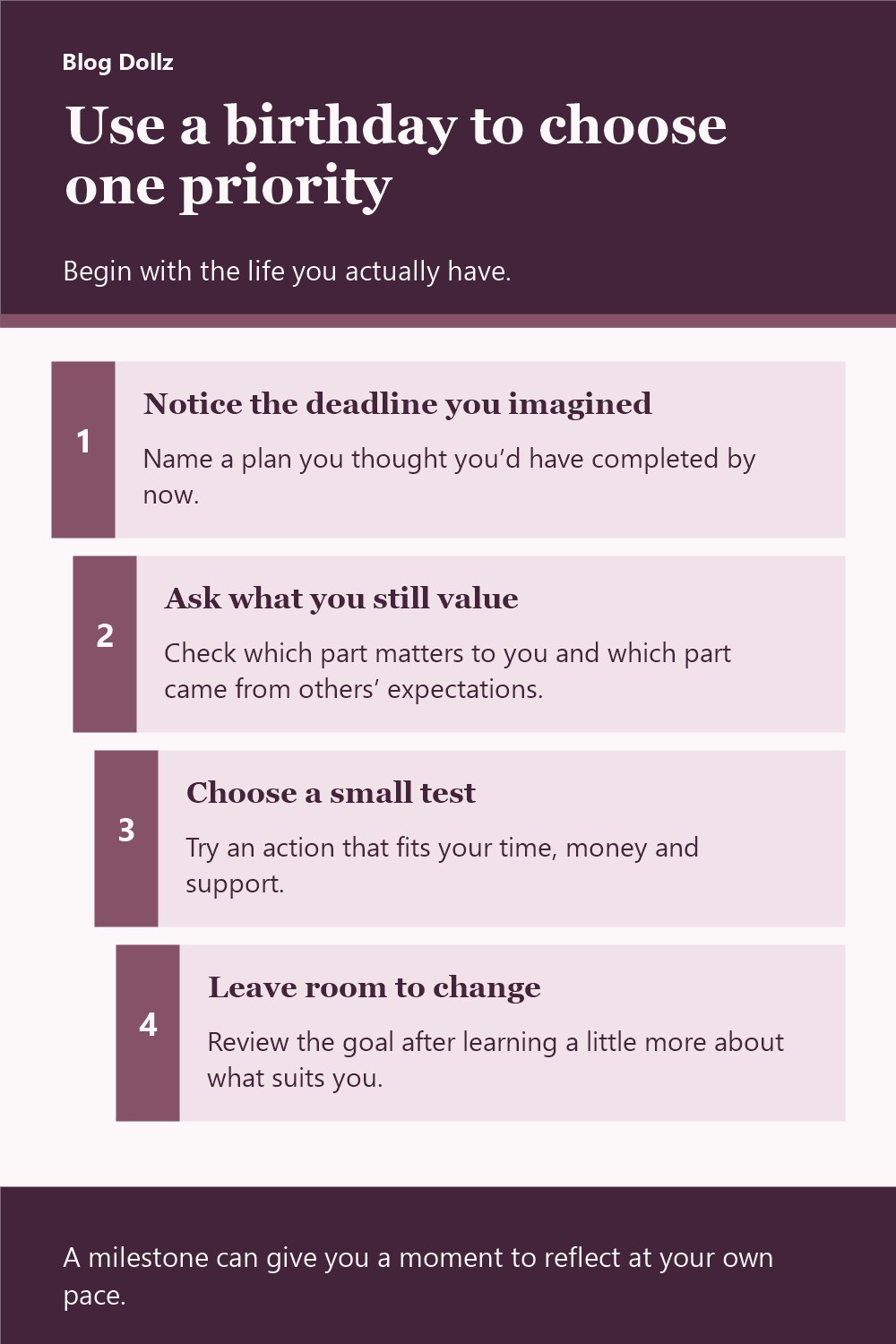
Use a birthday to choose one priority Begin with the life you actually have.
- Notice the deadline you imagined Name a plan you thought you’d have completed by now.
- Ask what you still value Check which part matters to you and which part came from others’ expectations.
- Choose a small test Try an action that fits your time, money and support.
- Leave room to change Review the goal after learning a little more about what suits you.
A milestone can give you a moment to reflect at your own pace.