

You may replay a conversation, keep reopening a decision or run through possibilities without reaching new information. Calling yourself an “overthinker” can add another judgement when what you need is a clearer question or a different kind of support.
These ten ideas offer starting points. You do not have to discard every difficult thought, decide everything quickly or make yourself calm before addressing a real problem. Choose one suggestion that fits the situation.
On this page
- Put the question into one sentence
- Separate information from interpretation
- Ask whether there is a practical action
- Try a short, bounded time to review concerns
- Give a small decision a proportionate limit
- Reduce one repeated check
- Return attention to one ordinary activity
- Look at the load you are carrying
- Ask for a specific kind of support
- Seek more help when worry is taking over
1. Put the question into one sentence
Replace a broad worry such as “Everything is going wrong” with the question you are facing: “Do I need to clarify tomorrow’s plan?” or “What information is missing from this decision?”
A specific question makes it easier to see whether another round of thinking adds anything. Write it down once if useful, without trying to record every thought that follows.
2. Separate information from interpretation
Note what you directly know and what you are guessing. “They ended the call quickly” is an observation; “They never want to speak to me again” is an explanation you may not have evidence for.
Consider other possibilities without forcing a positive answer. Repeated dishonesty or a broken agreement is relevant too. Balanced thinking does not require explaining away behaviour that concerns you.
3. Ask whether there is a practical action
Can you ask a clear question, check a reliable source or arrange help? Choose one action if it would add information. If no answer is available now, decide when to review the situation.
The NHS guide to tackling worries distinguishes practical problems from hypothetical worries and describes planning for what you can act on.
4. Try a short, bounded time to review concerns
The NHS guide also describes an optional “worry time”: a short period, such as ten to fifteen minutes, to note concerns and consider useful actions. If a concern returns later, remind yourself when you plan to review it.
Use this as an experiment, rather than suppressing thoughts or ignoring an urgent need. Adapt or stop it if it becomes a prolonged argument with yourself.
5. Give a small decision a proportionate limit
A routine choice may need less research than a decision about housing, health or a relationship. Before searching again, ask what information would actually change your answer.
For a low-impact, reversible choice, pick from two acceptable options and move on. A major decision may need time and appropriate advice; a strict thirty-second rule is not suitable for every situation.
6. Reduce one repeated check
Notice whether you keep rereading a message, refreshing a page or asking the same question without new information. Choose a manageable pause before the next check, or set a time to look again.
You can still follow an important update or a care plan. Distinguish a useful check from repeating an action that is no longer answering the question.
7. Return attention to one ordinary activity
Choose something available: make a drink, listen to a familiar song, notice your surroundings or talk with someone. Quiet reflection, prayer or meditation can be an option if welcome.
You do not have to empty your mind for the activity to count. If sitting still makes things harder, choose another activity or company. Movement does not make worry physically impossible, and rest remains an option.
8. Look at the load you are carrying
Before judging your concentration, ask whether the day needs to be more manageable. You might need food, rest, clearer instructions or help with a responsibility. Address the need you can, or ask someone to help.
Preparing for tomorrow can be useful, but an ideal morning routine is not a requirement for handling worry. Leave a non-essential task aside when the plan has become too demanding.
9. Ask for a specific kind of support
Tell a trusted person what would help: “Could you listen while I work out the next question?” or “Could you help me find the right service?” Ask for company without requiring them to guarantee the outcome.
For questions that remain open, read finding steadiness with uncertainty. You can also practise a pause with clear expectations and limits, rather than waiting without a plan.
10. Seek more help when worry is taking over
If repetitive worry is persistent, distressing or interfering with sleep, relationships or daily activities, speak with a qualified health or mental-health professional. Describe what happens and what you have tried.
The National Institute of Mental Health explains everyday care and when to seek professional help. You can ask before things become unbearable; self-help is not a test you must pass first.
For today, choose one useful action, one pause or one conversation. A worry returning does not mean that you failed.
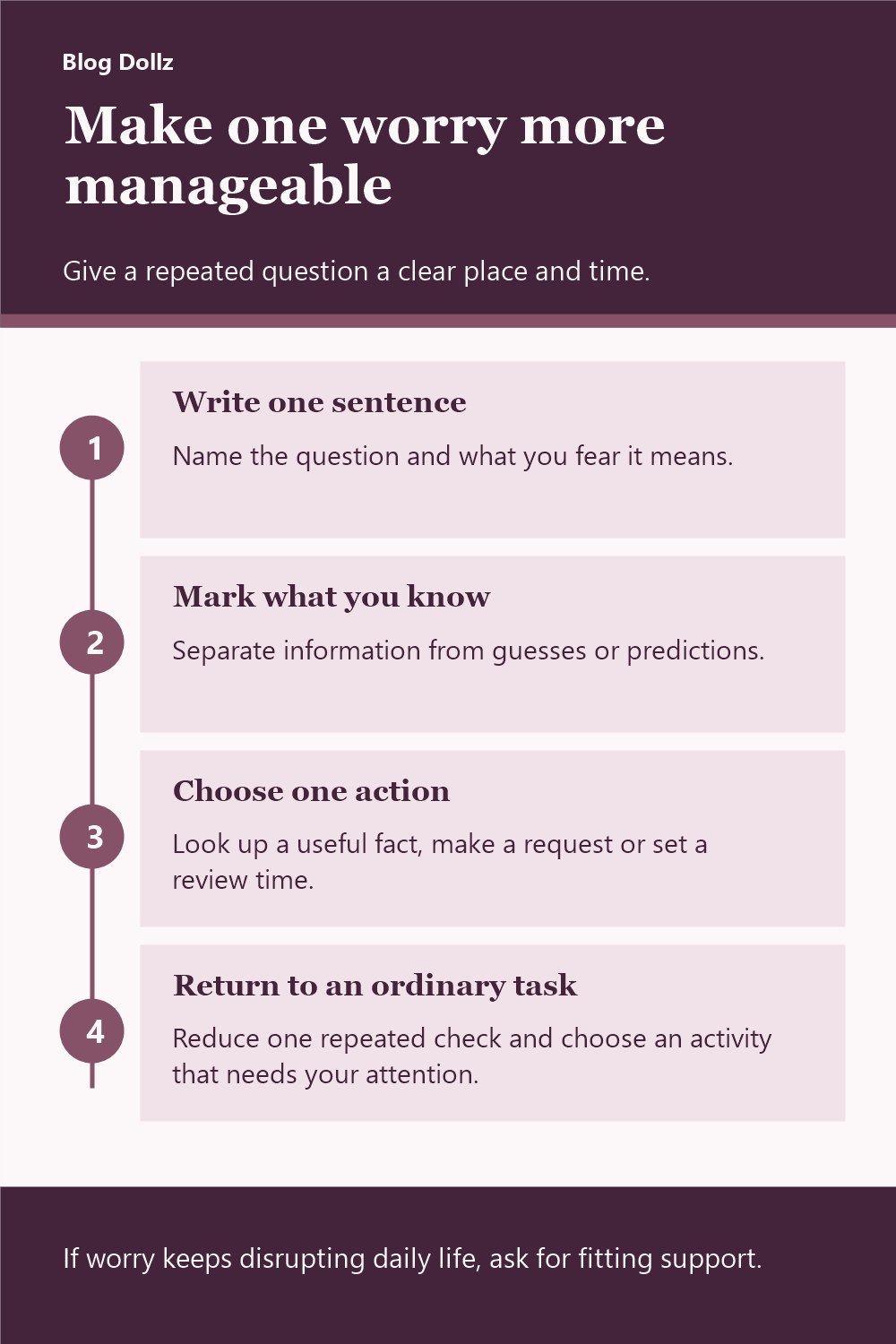
Read the infographic in text
Make one worry more manageable Give a repeated question a clear place and time.
- Write one sentence Name the question and what you fear it means.
- Mark what you know Separate information from guesses or predictions.
- Choose one action Look up a useful fact, make a request or set a review time.
- Return to an ordinary task Reduce one repeated check and choose an activity that needs your attention.
If worry keeps disrupting daily life, ask for fitting support.