

“Let’s take it slowly” can mean fewer dates, more time before sex, waiting to become exclusive or delaying a shared home. Without a conversation, two people can agree to the same phrase while expecting different things.
A useful pace is one you can both understand and freely choose. Moving slowly does not prove that someone is serious, and moving quickly does not establish that a relationship is only about attraction. Look at agreements and behaviour alongside the timetable.
On this page
Define what you mean by going slowly
Choose the part of the relationship you want more time with. You might say, “I would like to keep seeing you, but one date a week fits my life for now,” or “I want to know you better before planning a holiday together.”
Ask what the phrase means to the other person too. Are you both interested in continuing to date, or is someone uncertain about the relationship itself? An honest answer can be uncomfortable and still be more useful than guessing.
You can explain a preference without sharing every private detail of your past.
Keep sex and consent separate from a commitment test
You can want sex, want to wait or change your mind. Neither person owes physical intimacy to keep the relationship progressing, and earlier consent does not settle a later decision. Attraction does not remove the need to ask and listen.
Talk about boundaries clearly: “I enjoy being close to you, and I do not want to go further tonight.” A disappointed person is still responsible for respecting that answer.
Sex does not prove love or prevent a relationship becoming serious. For contraception, sexual health or testing questions, use a qualified healthcare service rather than assumptions about your dating pace.
Build connection in ordinary time together
Choose activities that leave room to talk and notice how you get along: a short walk, a meal or a shared interest. Expensive plans and constant messaging are not the only ways to show interest.
Ask ordinary questions about preferences, responsibilities and what each person wants from dating. Let answers develop without turning every date into an interview or looking for a perfect match in every detail.
Keep some existing routines and relationships where possible. A new connection can matter while you continue seeing friends, resting and choosing how to use your own time.
Notice consistency and respect alongside the pace
Does the person keep agreed plans, communicate changes and respond respectfully when you say no? Can you both ask a question or express a different preference? Those patterns tell you more than the word “slow” alone.
A missed message does not establish someone’s motives. Repeated broken agreements or pressure deserve attention. Our guide to responding to insecurity in a relationship separates observations, interpretations and requests.
If you fear threats or retaliation, prioritise support and safety rather than testing whether you can negotiate the pace more confidently.
Keep exclusivity and practical decisions explicit
Dating slowly does not automatically mean exclusive or non-exclusive. Ask what each of you expects, including whether you are seeing other people. You can decide that an arrangement does not suit you without demanding that the other person want the same thing.
Consider each practical commitment separately: meeting children or family, lending money, sharing passwords or moving in. Agreeing to one does not require agreeing to the next.
You can say, “I am enjoying this, and I am not ready to make that plan.” For more examples, see care and boundaries in relationships.
Review whether the pace still works for both of you
Choose a time to check in: “Could we talk again after a few more dates about what we each want?” The conversation is an opportunity to share information, not a deadline for sex or commitment.
Either person may want to continue, adjust the arrangement or stop dating. You cannot make the relationship work through patience alone. A useful pace leaves room for both people’s wishes, including an honest decision that they differ.
Read the infographic in text
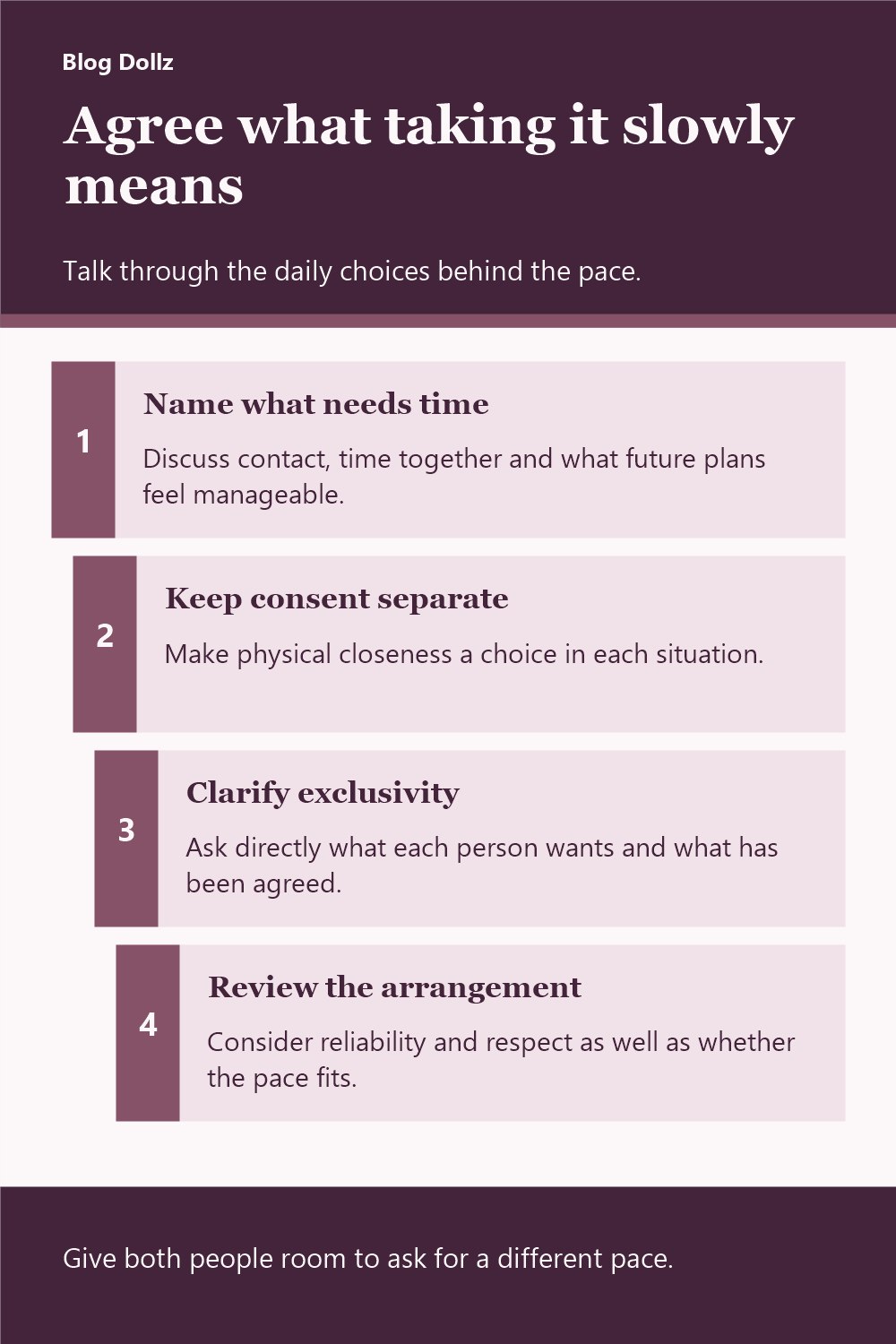
Agree what taking it slowly means Talk through the daily choices behind the pace.
- Name what needs time Discuss contact, time together and what future plans feel manageable.
- Keep consent separate Make physical closeness a choice in each situation.
- Clarify exclusivity Ask directly what each person wants and what has been agreed.
- Review the arrangement Consider reliability and respect as well as whether the pace fits.
Give both people room to ask for a different pace.