

Feeling empty can mean feeling numb, disconnected or unable to enjoy things that usually matter to you. You may not know how to describe it or why it is happening. It does not mean that you are soulless, ungrateful or failing to love yourself.
You do not have to solve your whole life today. The suggestions below offer different starting points; choose what fits, ask for help where needed and leave aside anything that adds pressure.
On this page
- Check whether you need urgent support
- Notice a pattern without diagnosing yourself
- Put your own words to the feeling
- Let care begin before self-love feels possible
- Make movement an option, not a demand
- Make eating more workable
- Notice sleep difficulties without another strict target
- Reduce one demand where you can
- Choose solitude or company according to what helps
- Ask for the kind of connection you need
- Separate responsibility from self-punishment
- Leave room for a small interest without forcing happiness
- Prepare one next conversation or action
Check whether you need urgent support
If you are thinking about suicide or are worried that you cannot stay safe, seek urgent help now. In the United States, call or text 988. For an immediate life-threatening emergency, call 911; elsewhere, use your local crisis or emergency service.
If possible, tell a trusted person plainly that you need help staying safe. You do not need to finish a self-care list before asking for urgent support.
Notice a pattern without diagnosing yourself
Consider when the feeling began, whether it comes and goes, and how it affects your day. A few notes about sleep, interest, appetite or concentration can help you explain what is happening.
The National Institute of Mental Health includes a persistent empty mood and loss of interest among possible depression symptoms. Emptiness alone does not establish a diagnosis. A healthcare professional can assess persistent changes and consider other explanations.
Put your own words to the feeling
Does “empty” mean missing someone, feeling detached, going through routines without enjoyment, or not knowing what you want? You can use an ordinary description rather than searching for the perfect label.
Try finishing one sentence: “The hardest part of today is…” You may find a practical need, a loss or an unanswered question. It is also okay if an explanation does not come yet.
Let care begin before self-love feels possible
You can receive care while feeling uncertain about yourself. Choose something concrete: a comfortable place to sit, clean clothes or help with a task that has become difficult.
Meditation and positive statements are optional. If sitting quietly makes things harder, try company or a familiar activity instead. This guide to everyday care without a confidence test offers more starting points.
Make movement an option, not a demand
If an activity feels accessible and wanted, you might step outside with someone, stretch comfortably or take a short walk. You can stop, change the activity or choose rest.
Exercise is not a promise that emptiness or depression will disappear. Our guide to support without exercise pressure explains how to offer company while respecting a person’s choices and care plan.
Make eating more workable
Ask what food is available and manageable today. A familiar meal, a simple snack or help with shopping may be more useful than a plan to change everything you eat.
If eating has become difficult, tell someone who can help, including a healthcare professional when needed. You do not need to divide food into moral categories or earn a meal by being productive.
Notice sleep difficulties without another strict target
Consider what makes rest difficult: noise, caring responsibilities, worry or an uncomfortable sleeping space. Identify one adjustment or one kind of help that might be available.
If sleep has changed persistently or is affecting daily life, mention it when seeking care. You do not need to reach a perfect number of hours before taking another need seriously.
Reduce one demand where you can
Look at what is essential today and what could wait, be shortened or be shared. A specific request may help: “Could you collect the groceries?” or “Can we move this conversation to tomorrow?”
Rest need not become another project. A pause can be quiet company, sitting somewhere comfortable or leaving a non-urgent task unfinished. You do not have to feel refreshed immediately for the pause to be allowed.
Choose solitude or company according to what helps
Time alone can feel welcome, painful or different from one day to the next. Notice what happens rather than assuming you must isolate to reconnect with yourself.
If you want company without a big conversation, ask directly: “Would you sit with me for a while?” You can choose a short visit or a familiar shared activity and leave room to change your mind.
Ask for the kind of connection you need
Someone may care about you and still not know what would be helpful. You could ask for listening, practical help or a check-in at an agreed time.
For example: “I have been feeling disconnected. I do not need you to fix it, but could we talk this evening?” If the first person is unavailable or responds poorly, that does not settle whether you deserve support.
Separate responsibility from self-punishment
If a particular mistake is troubling you, identify what can be repaired: an apology, corrected information or a different plan. Repeatedly attacking yourself does not tell you what to do next.
You can explore self-forgiveness as an optional reflection. You do not have to forgive someone, excuse harm or resume contact to receive care or begin making changes.
Leave room for a small interest without forcing happiness
A familiar song, a few pages of a book or an ordinary task may be something you want to try. Choose a version that does not demand a particular emotional result.
If nothing feels enjoyable, avoid turning that into another failure. You can tell a professional about the loss of interest rather than repeatedly testing yourself with more activities.
Prepare one next conversation or action
If the feeling persists, worsens or makes daily activities difficult, arrange a conversation with a healthcare or mental-health professional. You do not need to wait for things to become unbearable. Bring any notes about when it started and what has changed.
For today, choose one attainable action: ask for company, arrange an appointment or get help with an essential task. It can be small. You can seek support while the explanation is still unclear.
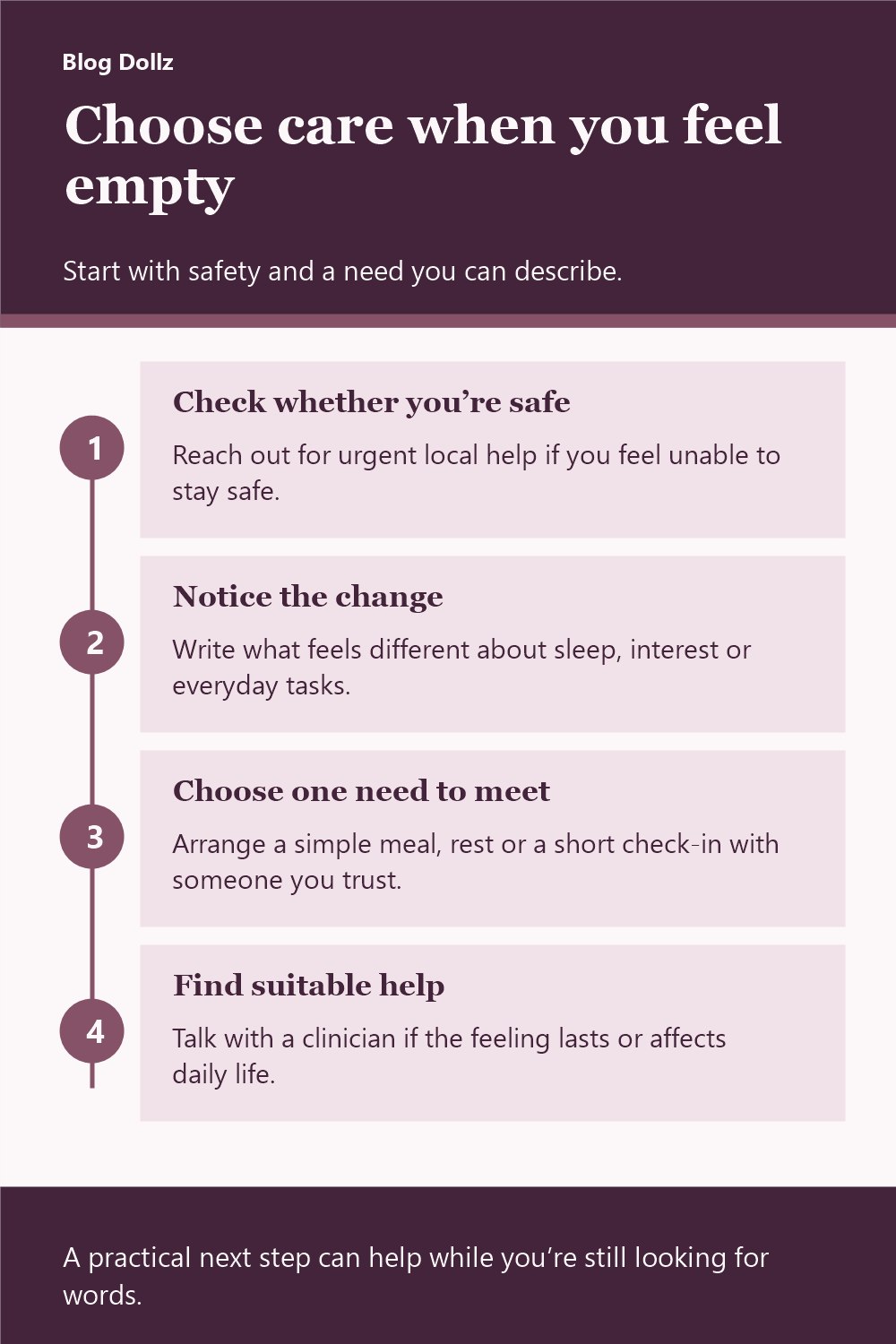
Read the infographic in text
Choose care when you feel empty Start with safety and a need you can describe.
- Check whether you’re safe Reach out for urgent local help if you feel unable to stay safe.
- Notice the change Write what feels different about sleep, interest or everyday tasks.
- Choose one need to meet Arrange a simple meal, rest or a short check-in with someone you trust.
- Find suitable help Talk with a clinician if the feeling lasts or affects daily life.
A practical next step can help while you’re still looking for words.