

If you are curious about auras, you may think of colours as a way to explore personal meaning, intuition or spiritual belief. That curiosity does not require a timed test. There is no need to prove that you can see someone’s energy in three minutes or keep your eyes fixed until an outline appears.
A useful approach separates what you notice from what you infer. A colour, impression or feeling cannot establish another person’s health, character or private emotions. You can explore symbolism while leaving room for uncertainty and respecting the person in front of you.
On this page
1. Understand aura language as belief
Different spiritual approaches describe auras in different ways. Some people associate colours with qualities such as warmth, steadiness or creativity. Those associations are interpretations; they do not form a reliable test of what someone is thinking or experiencing.
Ordinary scientific uses of the word “energy” do not, by themselves, verify an aura reading. You can say, “This colour makes me think of calm,” without turning that association into a fact about another person.
If you do not notice a colour or have an intuitive impression, you have not failed a test of spiritual worth. You are free to remain curious, uncertain or uninterested.
2. Keep visual effects in perspective
What appears around an object can be affected by lighting, contrast and the visual system. The American Museum of Natural History explains colour afterimages, in which a colour can appear after the eyes have adapted to another colour. Seeing an outline does not establish that an aura has been detected.
Avoid exercises that ask you to stare, suppress blinking or look toward bright lights. Blink normally and stop if your eyes feel uncomfortable. A spiritual practice does not need to depend on producing a visual effect.
3. Use colour for personal reflection
If colour symbolism appeals to you, try an ordinary creative prompt instead. Choose a colour from a pencil, a fabric or a paint swatch. Look at it comfortably, then ask what it brings to mind.
- What memory or quality do I associate with this colour?
- Does that association fit how I feel today?
- Is there a need or value I want to give more attention to?
Your answer might be different tomorrow or different from someone else’s. You can use a dark colour to express rest, elegance or sadness without treating it as evidence of illness or a “bad” person. No colour makes someone more loyal, intelligent or spiritually developed.
4. Respect other people’s privacy and choices
Ask before involving another person in a spiritual exercise or offering an interpretation. They can decline without explaining why. Avoid telling someone that a colour reveals a diagnosis, hidden hatred or a relationship outcome.
If you are concerned about a friend, ask how they are doing and listen to their answer. Their own account and observable needs are more useful than a colour label. You can offer company or practical help without claiming access to their inner life.
The same respect applies to yourself. You do not need to accept a frightening reading or pay someone to remove a colour they say is dangerous.
5. Look after your eyes
New visual symptoms deserve attention as eye-health concerns. NHS guidance recommends urgent assessment for new or suddenly increasing flashes or floaters, a moving shadow or curtain, or symptoms accompanied by blurred vision or eye pain. Do not assume they are signs of spiritual progress.
You can keep a spiritual interest in auras separate from decisions about eye care. For everyday reflection, choose a comfortable activity that does not involve eye strain, judging another person or seeking certainty about the future.
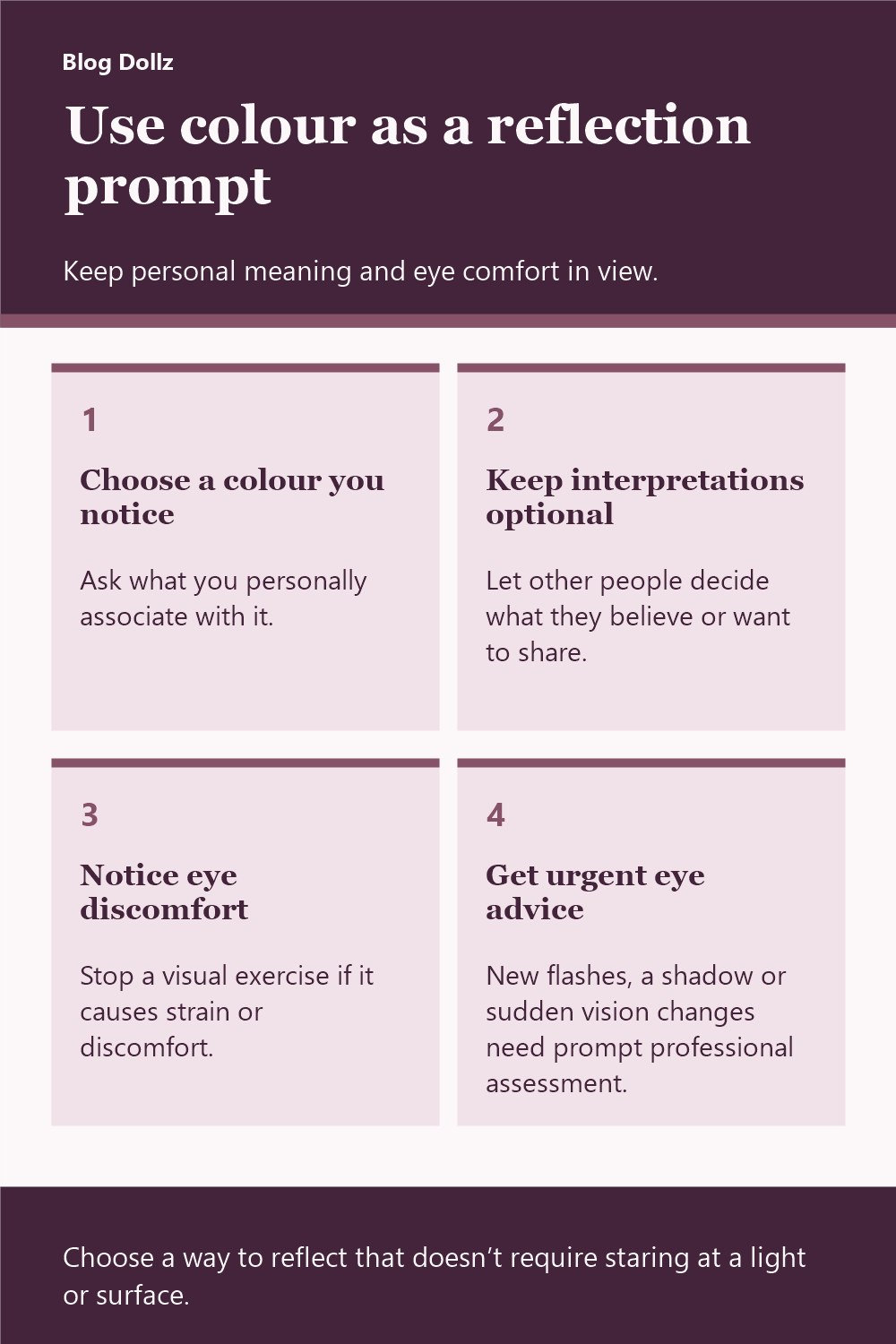
Read the infographic in text
Use colour as a reflection prompt Keep personal meaning and eye comfort in view.
- Choose a colour you notice Ask what you personally associate with it.
- Keep interpretations optional Let other people decide what they believe or want to share.
- Notice eye discomfort Stop a visual exercise if it causes strain or discomfort.
- Get urgent eye advice New flashes, a shadow or sudden vision changes need prompt professional assessment.
Choose a way to reflect that doesn’t require staring at a light or surface.