

“I made a mistake” describes an event. “I am useless” turns it into a much wider judgement. People often use the phrase “critical inner voice” for this kind of harsh self-talk: familiar thoughts that dismiss an effort, predict rejection or keep moving the standard you are expected to meet.
Start with a particular thought and situation, rather than trying to silence your mind completely. If your experience involves sounds or voices that other people do not hear, seek medical advice; the final section explains when to get more help.
On this page
- Notice the message and its effect
- Look for triggers without assuming one cause
- Separate useful responsibility from a global insult
- Write a balanced response you can believe
- Choose an action linked to the actual task
- Seek feedback and support that are useful
- Review without monitoring yourself all day
- Know when to seek more help
Notice the message and its effect
Choose a recent example. What did the thought say, what was happening and what did you do next? Perhaps you stopped drafting a message because you thought it would sound foolish, or dismissed useful work because one part needed revision.
Describe the effect without judging yourself for having the thought. A recurring criticism may feel familiar or convincing, but familiarity does not establish that it is accurate.
Look for triggers without assuming one cause
Notice whether the criticism becomes louder around tiredness, comparison, uncertain expectations or a particular interaction. Experiences of criticism may be relevant, including earlier ones, but you do not have to settle a complete explanation before trying a practical change.
The NHS guidance on low self-esteem describes several influences on how people see themselves. Avoid deciding that one parent, teacher or event must explain every thought you have now.
Separate useful responsibility from a global insult
A useful concern points to something you can consider: a missed agreement, an unclear request or an action that affected someone. An insult such as “I ruin everything” provides much less information.
Try asking, “Is there a specific repair, question or change needed here?” You can apologise, correct an error or seek feedback while still treating yourself with basic respect. Responsibility does not require repeating a personal attack.

Write a balanced response you can believe
Use a short sequence: name the thought, check the facts and add a fairer account. For example: “I am having the thought that everyone disliked my contribution. Two people asked useful questions; I do not know what everyone thought.”
You do not have to replace criticism with extravagant praise. A credible response might be, “This part needs practice, and I can ask which detail is unclear.” Keep it brief enough that checking does not become an endless argument with yourself.
Choose an action linked to the actual task
After identifying the concern, choose something specific: clarify the deadline, revise one paragraph or ask a question. The action can be small, and you can take it while still feeling unsure.
Our guide to building confidence in a particular situation offers preparation and practice ideas. If the demand is unrealistic or the setting is inaccessible, changing the arrangement may matter more than changing your self-talk.
Seek feedback and support that are useful
Ask someone with relevant knowledge for a specific observation: “Which part of this explanation needs more detail?” That gives you something to work with instead of asking them to decide whether you are a capable person.
Support can also mean company, help with a task or discussing a recurring difficulty with a qualified professional. You do not have to prove that you can manage every thought alone.
Review without monitoring yourself all day
Check back after a task or at a convenient point. Did the balanced response help you act, ask for support or keep a limit? If it did not, consider a different approach rather than adding criticism about doing self-help incorrectly.
You can notice repeated patterns without recording every thought. Our guide to making decisions you can review explores flexible plans and learning from outcomes. The aim is a workable response, not a permanently positive mind.
Know when to seek more help
If self-criticism is persistent, overwhelming or affecting sleep, relationships or daily responsibilities, consider speaking with a qualified mental-health professional. Describe the experience in your own words, including what it feels like and when it happens.
If you hear sounds or voices that other people do not hear, get prompt medical advice rather than assuming the label “inner critic” explains them. The NHS guidance on hearing voices explains that different causes need assessment.
Seek immediate local emergency help if voices tell you to harm yourself or someone else, you might act on an urge to harm, or there is sudden confusion or rapidly worsening symptoms. You deserve support that takes the experience seriously without blaming you.
Read the infographic in text
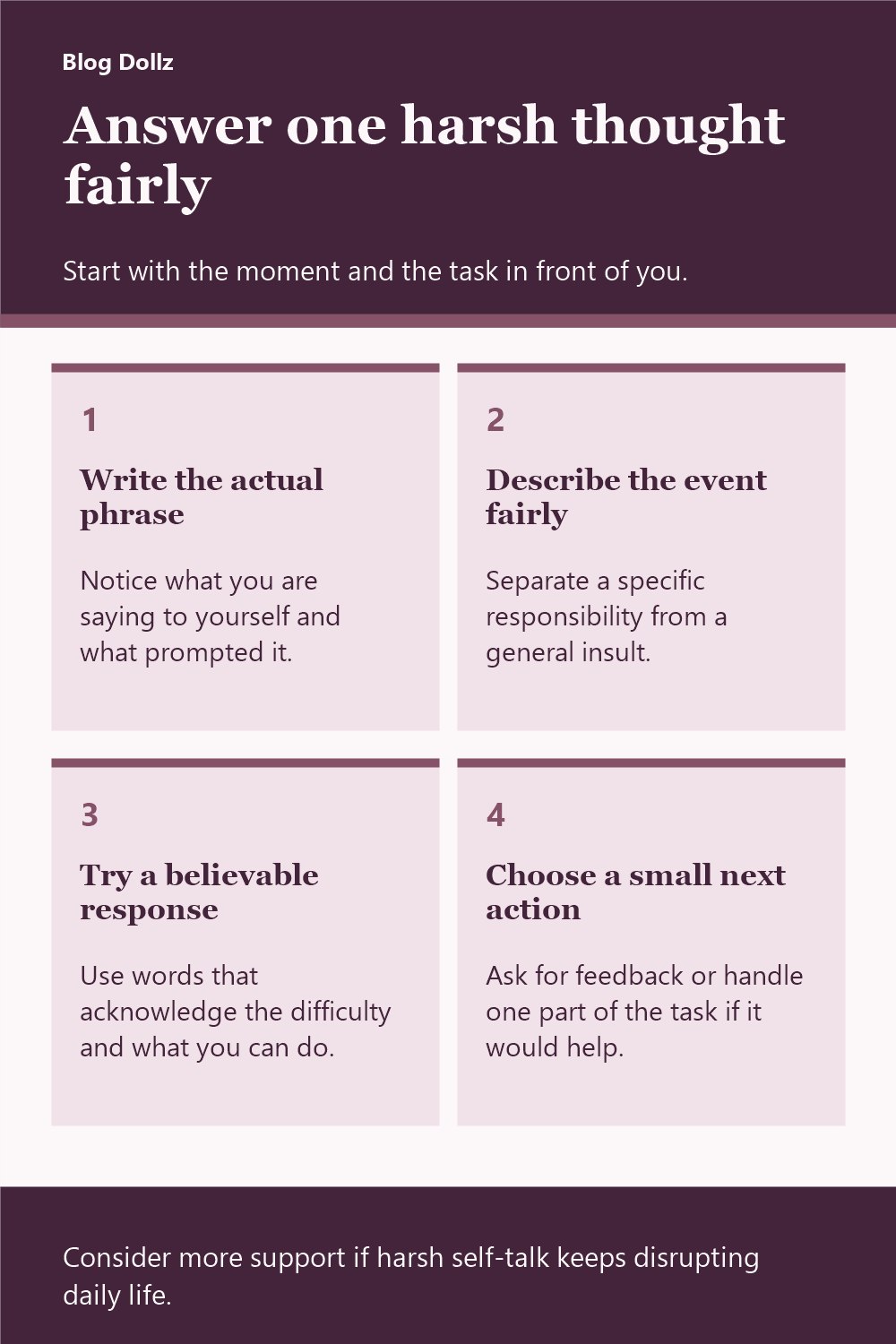
Answer one harsh thought fairly Start with the moment and the task in front of you.
- Write the actual phrase Notice what you are saying to yourself and what prompted it.
- Describe the event fairly Separate a specific responsibility from a general insult.
- Try a believable response Use words that acknowledge the difficulty and what you can do.
- Choose a small next action Ask for feedback or handle one part of the task if it would help.
Consider more support if harsh self-talk keeps disrupting daily life.