

A career change can be worth exploring when your work no longer fits your interests, circumstances or needs. It is also a decision with practical consequences. You do not have to resign, enrol on a course or identify a perfect calling before you can investigate your options.
Start with the change you want in everyday life. A different employer, a revised role or a change in working arrangements may answer that need; moving into a new field is another possibility. These seven steps can help you compare those routes without promising that any one of them will make work stress-free.
On this page
1. Name what you want to be different
“I need a new career” may contain several concerns: unpredictable hours, limited progression, work you dislike, an inaccessible environment or too little income. Identify which concerns matter most and which are specific to your current workplace.
Try describing one ordinary week. Which tasks interest you? What leaves you drained? What arrangement would make the week more workable? Keep desired conditions separate from a particular job title for now.
You do not need to criticise yourself for staying in a job that pays the bills. Our guide to self-reflection without self-criticism offers a way to review a situation without turning it into a judgment of your worth.
2. Compare a new field with smaller changes
Consider more than one route:
- Adjust the current role: clarify responsibilities, discuss a different schedule or investigate available support.
- Move within the same field: compare employers, teams or roles that use skills you already have.
- Change field: investigate different work, including its entry requirements and everyday demands.
Some workplaces cannot or will not offer what you need. You are not required to exhaust every conversation before exploring elsewhere. At the same time, a new field may reproduce an unwanted feature, such as irregular hours, unless you check it directly.
England’s National Careers Service discusses career changes later in life, including adjustments to an existing role and plans for a new one. Age alone does not answer which option will fit your resources and goals.
3. Match your existing skills to actual job requirements
Choose a few current vacancies or official occupational profiles in the place where you want to work. Look at the tasks, required qualifications, hours, location and advertised pay rather than relying on a general claim that an industry is growing.
Next, identify examples of work you can already do. Coordinating appointments may show organisation; explaining a process to a customer may show communication. Use an example that reflects your actual responsibility rather than describing yourself as an expert in a field you have not entered.
The National Careers Service’s skills and training guide suggests comparing job descriptions, reflecting on experience and identifying skills to develop. A qualification is one possible route, alongside relevant experience and learning at work.
Separate essential requirements from preferences, and ask the employer or relevant professional body when a requirement is unclear. This can help you avoid paying for training that does not address the role you want.

4. Learn about the work behind the attractive title
If possible, ask someone in the field about a normal day: the tasks they repeat, the difficult parts, the entry route and the working pattern. One person’s experience is useful information, not a promise that every workplace is similar.
You might attend a free introductory event, try a small sample task using public materials or look for appropriate work experience. Choose an option that fits your time and access needs. Unpaid work is not automatically necessary or affordable.
Write down what the exploration changes. Are you still interested in the daily tasks? Is an important condition missing? Finding that a role does not suit you can be a useful result before making a larger commitment.
5. Check the purpose and conditions of a course
Before enrolling, confirm which gap the course would address. Check the provider, the qualification awarded, any required recognition for the occupation, and whether employers you are considering ask for it.
Compare the full demands: tuition and assessment fees, materials, equipment, travel, placements and study time. For online learning, ask about attendance times, live sessions, practical requirements and support. “Online” does not necessarily mean that you can study whenever you choose.
Read completion requirements, payment and cancellation conditions directly with the provider. Ask about available support or funding without assuming you qualify. A course cannot guarantee employment, promotion or a particular salary.
6. Make the plan fit your money, time and support
Consider income you need to maintain, existing responsibilities and any period of reduced earnings or added study costs. Use figures you can check, and distinguish a confirmed arrangement from something you hope will become available.
Discuss practical support where it is relevant: childcare, shared tasks, travel, access needs or time for study. Family commitments, health and limited savings may affect your options without making your interest in change unrealistic or your current choice a failure.
Consider whether you can explore while remaining employed, apply directly for suitable roles, spread training over time or postpone a larger move. For a specific question about benefits, employment rights or a financial commitment, seek appropriate local advice before relying on an assumption.
7. Choose one next step and a review point
Make the next action small enough to complete: compare three vacancies, ask one employer about a requirement, revise one part of your CV or request a course timetable. Choose a reasonable time to review what you have learned.
Ask whether the new information supports the move, suggests a different route or leaves an important question open. You can revise a plan without treating the earlier effort as wasted.
Your job can provide income, interest, connection or a combination of these. It does not have to express every part of your identity. A useful decision is one that considers the work actually available and the life you need it to fit.
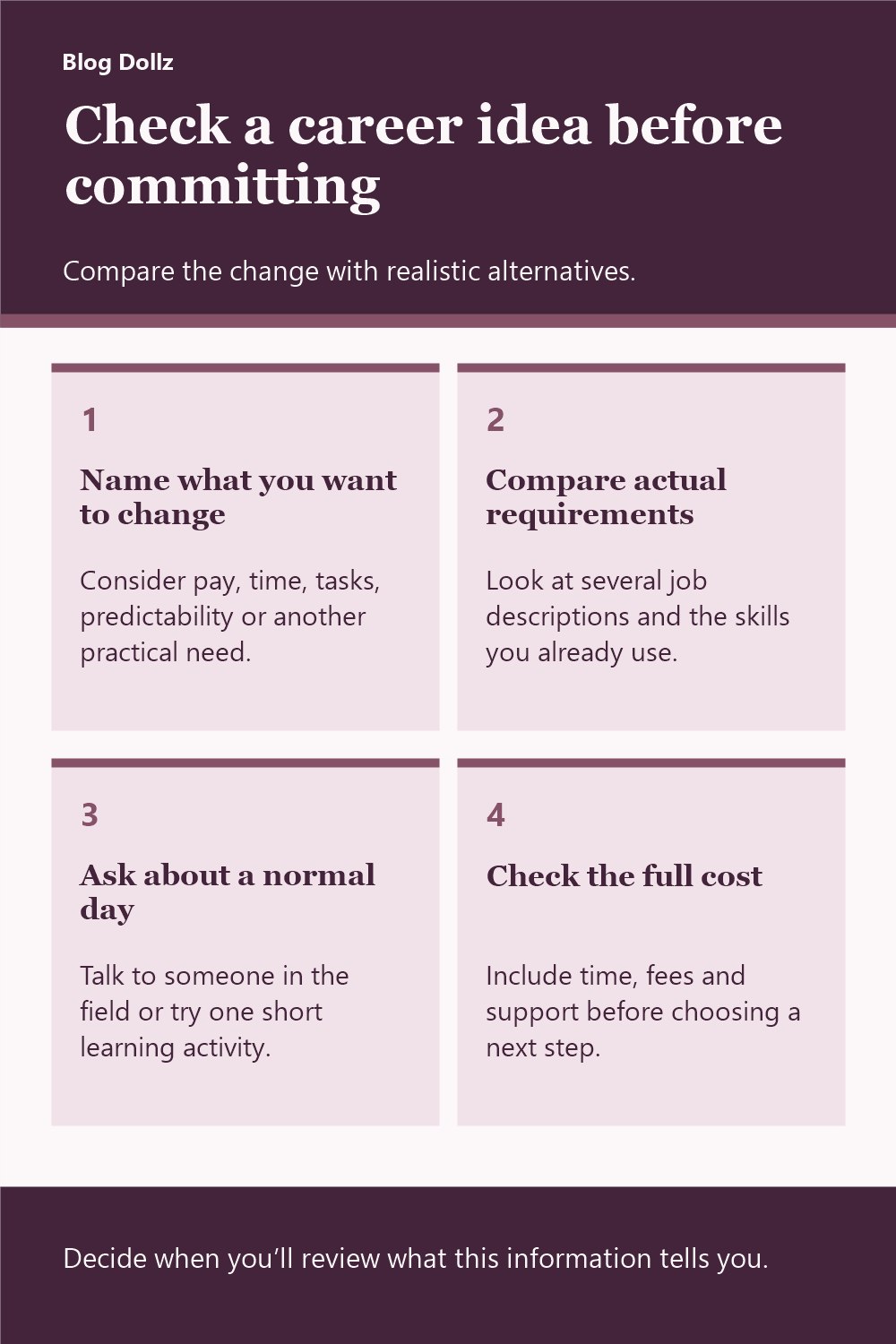
Read the infographic in text
Check a career idea before committing Compare the change with realistic alternatives.
- Name what you want to change Consider pay, time, tasks, predictability or another practical need.
- Compare actual requirements Look at several job descriptions and the skills you already use.
- Ask about a normal day Talk to someone in the field or try one short learning activity.
- Check the full cost Include time, fees and support before choosing a next step.
Decide when you’ll review what this information tells you.