

Trusting yourself does not mean knowing every answer, feeling certain or succeeding each time. It can mean using a process you are willing to return to: understanding the decision, gathering enough information and checking whether the result still fits your needs.
Your worth is not a reward for making good decisions. You can learn from an error, take responsibility where needed and receive support without deciding that you are incapable.
On this page
- Give yourself a clear decision to work with
- Separate your influence from the outcome
- Gather enough information for a proportionate step
- Use a credible account of your abilities
- Treat uncertainty as information, not a verdict
- Review a mistake and repair what you can
- Make commitments that include support and limits
- Use a short decision record and review point
Give yourself a clear decision to work with
Choose one current question. “Can I trust myself?” is difficult to answer as a whole-life judgement. “Can I reasonably take on this commitment?” gives you something to examine.
Name the options, the deadline and the people affected. Check whether a decision is actually needed now or whether you are being rushed. Where possible, ask for time to understand what agreeing would involve.
Separate your influence from the outcome
You can prepare for an interview, ask clear questions and decide whether a role suits you. You cannot control every hiring decision or know why someone else was selected. An unwanted outcome does not prove that your preparation was worthless.
Look for information before inventing an explanation. Rejection can involve circumstances you do not know, and barriers such as unfair treatment or limited access deserve attention rather than self-blame.
Gather enough information for a proportionate step
Ask what you need to know to choose responsibly. For a new commitment, that might include cost, time, accessibility and what happens if you need to withdraw. A decision with major consequences may need qualified advice.
Set a reasonable point to stop gathering information. If the choice is small and reversible, a limited trial may teach you more than repeated checking. If key information is missing, pausing can be a considered action.
Use a credible account of your abilities
Replace a global verdict with a specific observation. Instead of “I never follow through,” try “I agreed to too much last week; this plan needs less time or more support.” The second statement gives you a change to make.
Our guide to building confidence around a practical situation offers preparation and feedback ideas. You do not need a cheerful slogan or a promise of success to begin.
Treat uncertainty as information, not a verdict
Feeling nervous may tell you that a decision matters, that something is unfamiliar or that you need more information. It does not reliably predict failure, and you do not have to relabel it as excitement.
Ask what the concern is about. Is there a practical risk to address, a limit you want to keep or a question that cannot be settled today? If anxiety repeatedly restricts daily life, consider professional support rather than trying to reason through every worry alone.
Review a mistake and repair what you can
Look at what happened, what you knew at the time and what you can change now. A decision can be reasonable with the available information and still have a disappointing result. It can also reveal something you need to do differently.
If someone was affected, acknowledge the action and discuss a practical repair. Our guide to reviewing a setback separates responsibility from condemning your whole character.
Make commitments that include support and limits
Choose a commitment you can describe clearly: “I will compare two options on Saturday,” rather than “I will fix everything this month.” Consider energy, health, money and responsibilities before deciding what is realistic.
Plan what you will do if circumstances change. You might reduce the task, request help or tell someone promptly that you cannot meet the original agreement. Revising openly is different from pretending the commitment never existed.
Use a short decision record and review point
Try four notes: what you chose, why it mattered, what information you used and when you will review it. Keep the record brief enough that it supports a decision instead of becoming another checking ritual.
At the review point, ask whether to continue, adapt or stop. Advice from someone with relevant knowledge can help while leaving you room to consider your priorities. Self-trust can include saying, “I have learned something new, and I am changing the plan.”
Read the infographic in text
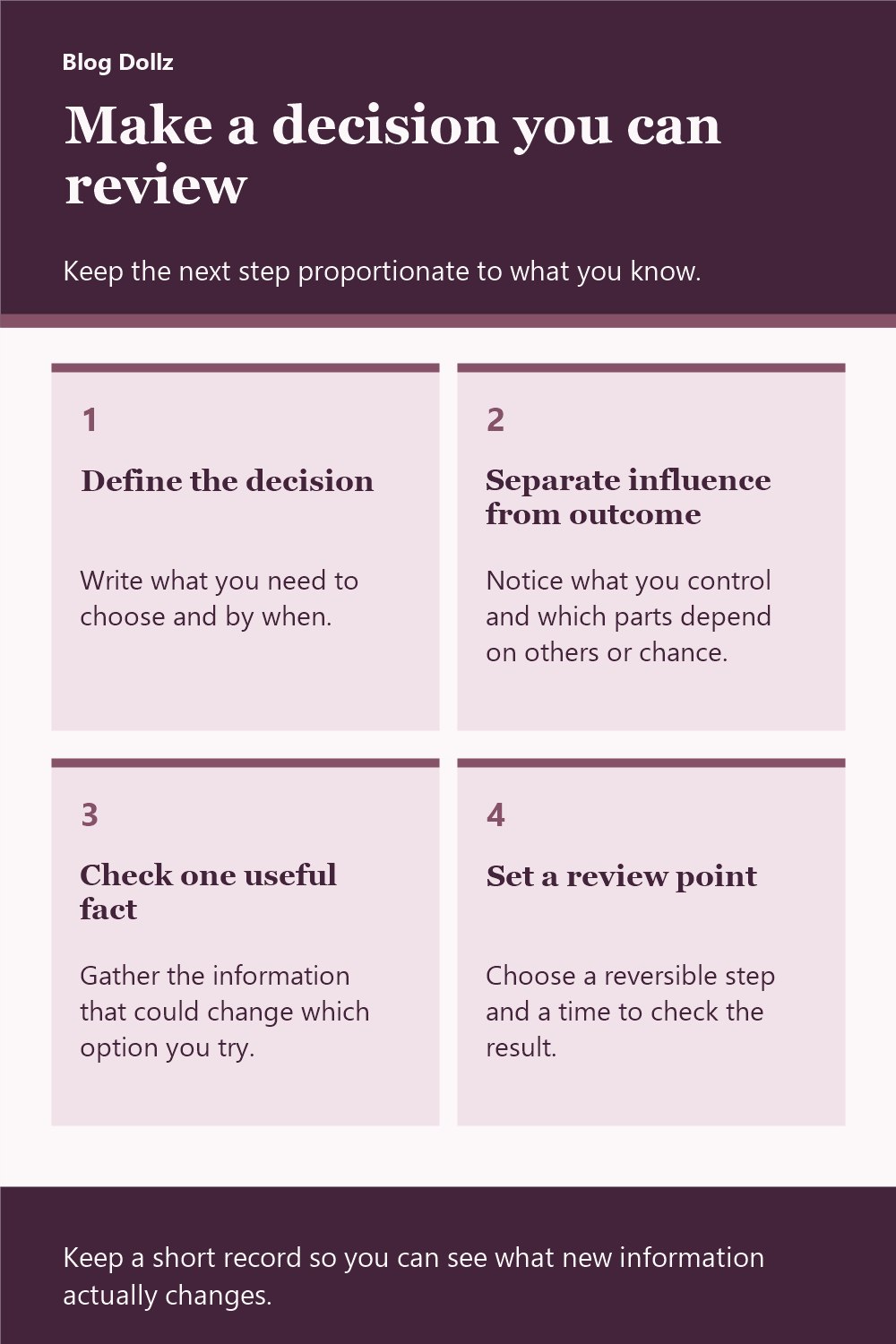
Make a decision you can review Keep the next step proportionate to what you know.
- Define the decision Write what you need to choose and by when.
- Separate influence from outcome Notice what you control and which parts depend on others or chance.
- Check one useful fact Gather the information that could change which option you try.
- Set a review point Choose a reversible step and a time to check the result.
Keep a short record so you can see what new information actually changes.