

When thoughts are crowded and ordinary decisions feel harder, being told to “just relax” may add frustration. You might need a pause, help with a task, a quieter setting or someone to listen. There is no single technique that has to work for everyone.
Start by checking what is needed right now. Is there something urgent to address, or can a non-essential demand wait? Choose one option below rather than turning a difficult moment into a long self-improvement assignment.
On this page
- Try comfortable breathing, if it helps
- Choose an external anchor instead
- Stop trying to produce a perfectly quiet mind
- Check one ordinary need
- Make a pause specific and workable
- Choose comfort without demanding happiness
- Ask for company that respects your preferences
- Use sound or quiet deliberately
- Choose movement or rest that fits
- Seek more support when a reset is not enough
Try comfortable breathing, if it helps
Find a position that feels supported. If paying attention to your breath is comfortable, let it stay gentle and regular without forcing a large breath or holding it. You can leave counting out.
The NHS breathing guide describes a gentle approach. If focusing on breathing makes you more uncomfortable, stop and try an external point of attention instead. You do not need to complete an exercise to earn a break.
Choose an external anchor instead
You could notice the colour of an object, the support of a chair or a familiar sound. Keep your eyes open if that feels better. Describe something simple and present without demanding that every thought disappear.
Meditation is an option if you already find it useful. It is not required, and you can end or adapt it when it does not suit the moment.
Stop trying to produce a perfectly quiet mind
Thoughts may continue while you pause. That does not mean you are doing something wrong. You can notice that a worry has returned and choose whether it needs action now, later or support from someone else.
For a problem that keeps looping, our guide to making a worry more manageable offers ways to separate a practical question from repeated checking.
Check one ordinary need
Ask whether hunger, discomfort, noise or an unfinished essential task is adding to the load. An easy meal, a drink, a more comfortable seat or help with a responsibility may be more useful than another technique.
Choose what is accessible. If money, housing, health or caring demands are part of the problem, practical assistance matters. These pressures are not evidence that you have failed to think positively.
Make a pause specific and workable
If you can step away, decide what the pause is for and what will happen afterwards. For example: “I will sit somewhere quieter, then ask which of these tasks is the priority.”
You may need someone to cover a responsibility or agree to a later conversation. A pause can help you decide; it does not have to solve every problem before you return.
Choose comfort without demanding happiness
A familiar room, a warm layer or a quiet activity may offer a little comfort. If imagining a pleasant place appeals to you, try it. If imagery feels difficult or upsetting, use something ordinary around you instead.
You do not need to feel grateful or cheerful about a painful situation. Ask what would make the next part of the day more bearable, even if your mood stays mixed.
Ask for company that respects your preferences
Tell a trusted person what would help: “Could you sit with me?” or “Can I talk this through without advice yet?” A hug can be welcome when both people want one; touch is not a requirement for feeling supported.
You can ask for practical help too, such as sharing a task or making a call together. The other person may have limits, so it can help to identify more than one source of support.
Use sound or quiet deliberately
Music, a familiar recording or a quieter environment may suit different moments. Choose something you find comfortable, at a volume that works for you. You can turn it off if it adds to the overload.
If upsetting news or repeated notifications are making it harder to think, consider pausing non-essential input while keeping access to any contact or information you need.
Choose movement or rest that fits
If wanted and accessible, a short walk, a stretch or changing position can be an option. Rest is an option too. Adapt the choice to pain, fatigue, disability, surroundings and any guidance you already follow.
There is no required amount of exercise here and no promise that movement will remove distress. Look for an action that is manageable, rather than another standard to meet.
Seek more support when a reset is not enough
If distress keeps returning, worsens or affects sleep, relationships or daily responsibilities, consider speaking with a qualified professional. You can describe what is happening, how long it has been going on and what you have already tried.
The NIMH guide to caring for mental health explains when to seek help. If you might hurt yourself or are in immediate danger, contact local emergency or crisis support now; in the United States, call or text 988.
For today, one useful outcome may be recognising the need for help and arranging it. You do not have to become calm before asking.
Read the infographic in text
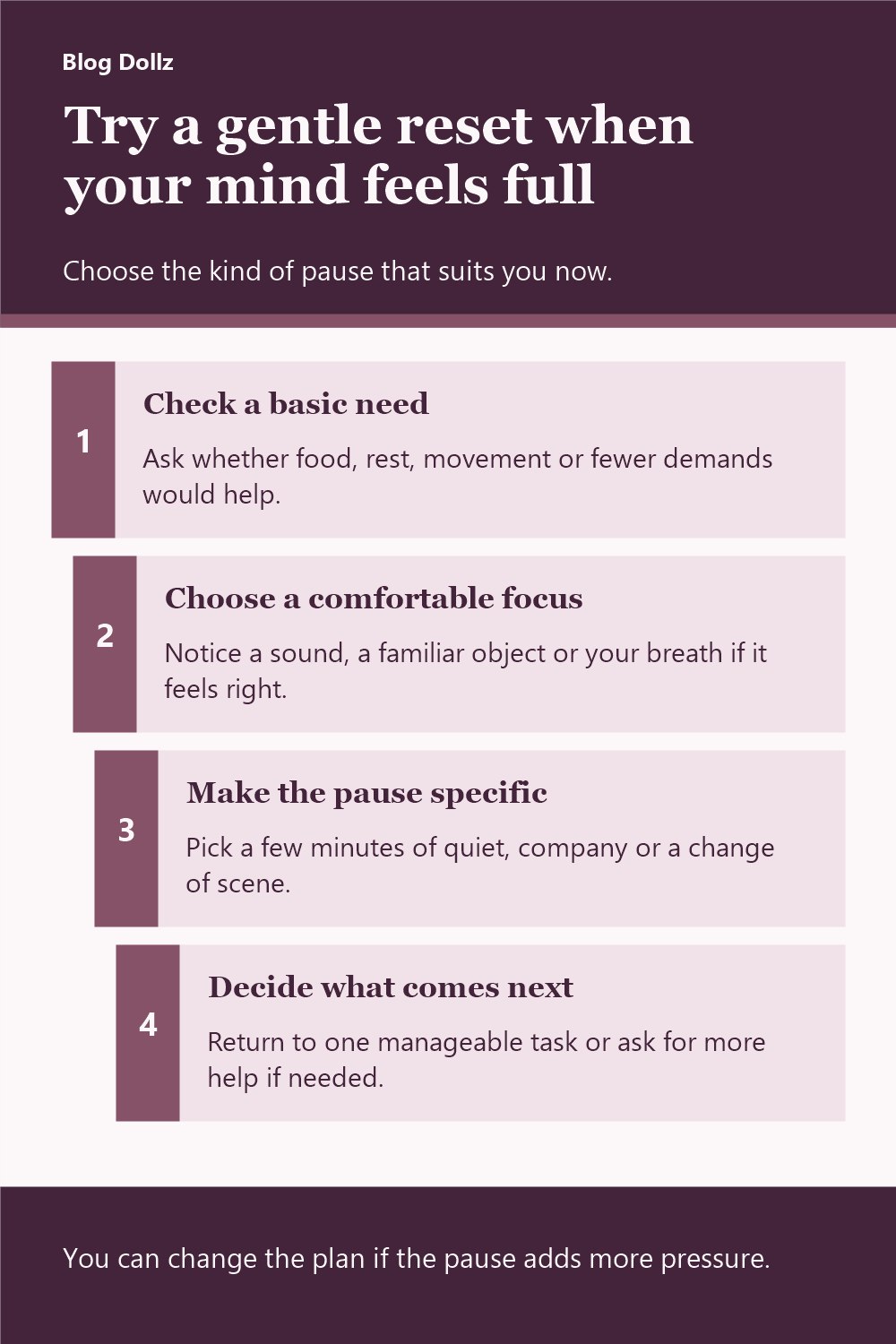
Try a gentle reset when your mind feels full Choose the kind of pause that suits you now.
- Check a basic need Ask whether food, rest, movement or fewer demands would help.
- Choose a comfortable focus Notice a sound, a familiar object or your breath if it feels right.
- Make the pause specific Pick a few minutes of quiet, company or a change of scene.
- Decide what comes next Return to one manageable task or ask for more help if needed.
You can change the plan if the pause adds more pressure.