

You may know a relationship has ended and still miss the person. A familiar place, an ordinary evening or an unexpected message can bring those feelings back. Caring about an ex does not oblige you to reconnect, and you do not have to stop caring before you can look after your present life.
Focus on the decisions available now: how you handle contact, what you do with reminders and who can support you. The aim is room to live, rather than a deadline for feeling nothing.
On this page
- Separate a feeling from a decision
- Choose contact arrangements that fit your situation
- Plan for moments when you want to reach out
- Give reminders a place you choose
- Rebuild one part of everyday life
- Ask for support without a performance of being over it
- Review your choices without measuring every feeling
Separate a feeling from a decision
Try naming what you miss. It might be the person, companionship, a familiar routine or the future you imagined together. More than one answer can be true, including relief about some parts ending.
A feeling does not settle whether contact or reconciliation would be helpful. If you are considering another relationship with your ex, our guide to weighing feelings alongside boundaries and concrete changes explores that separate decision.
Choose contact arrangements that fit your situation
Less contact may be useful if conversations keep reopening hopes or conflict. You might mute non-essential updates, stop late-night chats or take a break from personal messages. Choose a limit for your own needs, rather than as a strategy to make your ex return.
Shared parenting, work, housing or care can require ongoing communication. If it is safe and workable, agree on a channel and keep messages focused on necessary arrangements. You do not have to discuss the breakup during every practical exchange.
When there are threats, harassment or controlling behaviour, seek specialist advice about safer communication choices. The National Domestic Violence Hotline’s safety-planning information offers a starting point in the United States. A blanket instruction to delete every contact route may not fit your circumstances.
Plan for moments when you want to reach out
Notice when the urge is strongest: after a difficult day, when a memory appears or after checking their profile. If there is no urgent practical reason to send a message, you can pause before deciding.
Write what you hope the conversation would give you. Do you want comfort, an explanation or company? Consider another way to meet that need, such as asking a friend for a short call. You can also write an unsent message and decide later whether any part actually needs to be communicated.
Give reminders a place you choose
You can put photographs or gifts away without deciding their permanent fate today. Muting a feed or moving a keepsake out of daily view can be a temporary choice. There is no requirement to erase the good parts of your history to acknowledge that the relationship ended.
If a reminder brings mixed feelings, describe both sides: “I enjoyed those visits, and the relationship no longer works for me.” You do not need to turn your ex into either a perfect person or a villain to make sense of your own experience.
Rebuild one part of everyday life
Look for a specific gap the relationship left. If evenings feel empty, arrange one shared meal or return to an activity you used to enjoy. If practical tasks have changed, ask for help with the part you do not yet know how to manage.
Keep plans within your energy, budget and responsibilities. A new wardrobe, holiday or pet is not a requirement for recovery. An ordinary routine can be useful without becoming a dramatic fresh start.
Ask for support without a performance of being over it
Tell someone what would help: listening, company or a reminder not to send an impulsive message. You can set limits on breakup conversations too, especially if retelling the same details leaves you more distressed.
If feelings are persistently affecting sleep, daily tasks or your ability to function, consider a qualified mental-health professional. You do not have to prove that enough time has passed before asking for support.
Review your choices without measuring every feeling
Instead of checking whether you still love your ex, ask whether your current arrangements are serving you. Are messages mostly about necessary matters? Do you have support outside the former relationship? Is there a routine that makes the week more manageable?
You may need a different boundary or more help, and a difficult day does not erase earlier progress. Our guide to handling news that an ex has moved on covers updates and shared events. Your next choice can reflect present needs even while feelings remain unsettled.
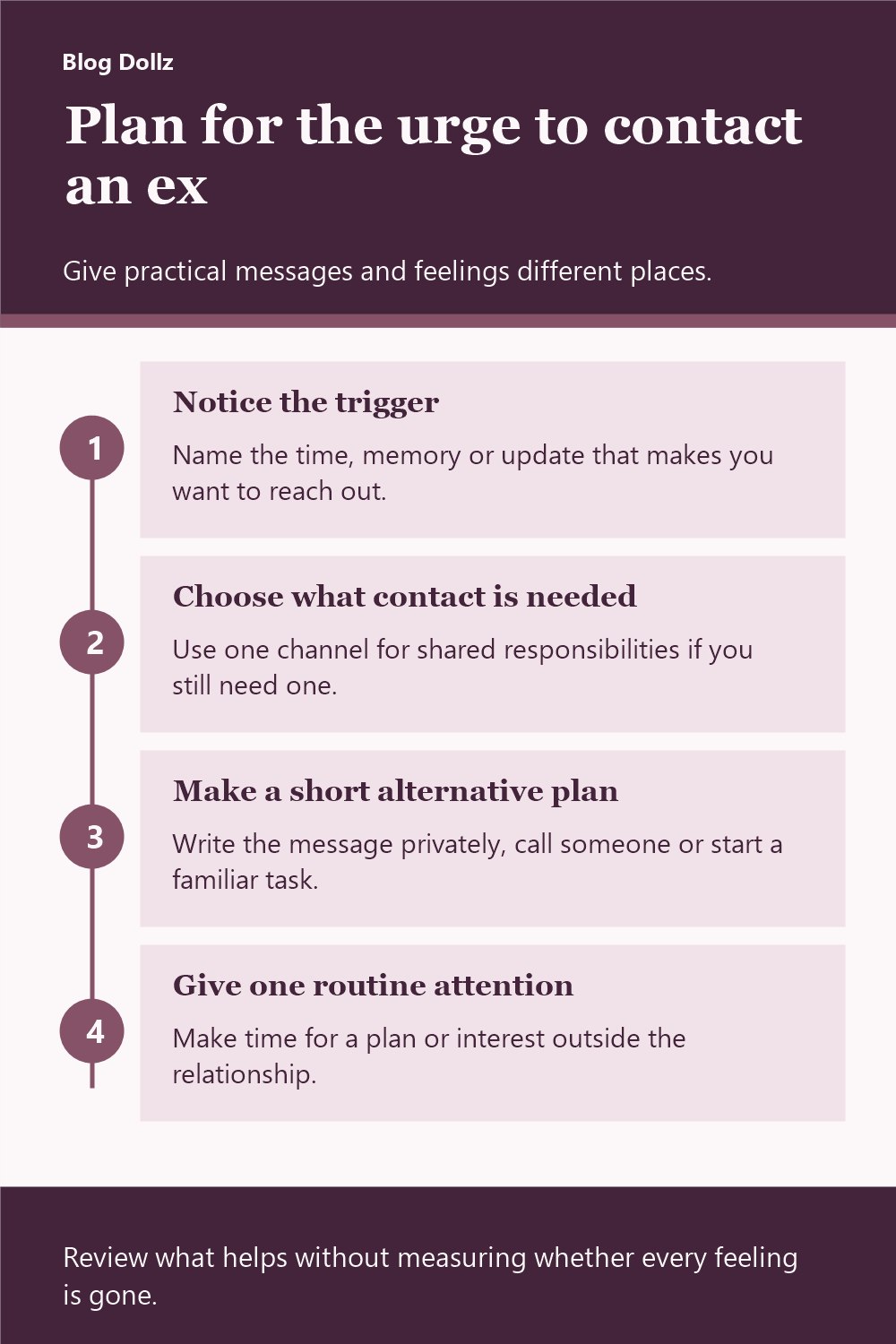
Read the infographic in text
Plan for the urge to contact an ex Give practical messages and feelings different places.
- Notice the trigger Name the time, memory or update that makes you want to reach out.
- Choose what contact is needed Use one channel for shared responsibilities if you still need one.
- Make a short alternative plan Write the message privately, call someone or start a familiar task.
- Give one routine attention Make time for a plan or interest outside the relationship.
Review what helps without measuring whether every feeling is gone.